Wade Walton is a unique individual having
spent his entire life in
Clarksdale, cutting hair and slapping
out blues rhythms on his razor
strap. A barber for 55 years Wade has
probably known more blues
performers and has performed for and with
more blues performers
than anybody else around the Clarksdale
area.
No trip to Clarksdale would be complete
without a trip to Wade Walton's
barber shop. Many a Blues fan has
made the trip to sit in his chair and
listen to him talk about and perform the
Blues. A great guitarist and harp
player in his own right he's also a mean
barber so you get double your
money's worth.
Wade is a favorite performer at Blues Festivals
and he brings along his
razor strap to show folks how it's done.
Copyright by Larry Heyl and Vivian Heyl,
1997
Delta Boogie
The following is taken from the liner notes
of Shake 'Em on Down:
PARCHMAN FARM is a musical dramatization
of a very real incident involving Wade, myself [Dave Mangurian], and Don
Hill a friend of mine from Pomona College. During our summer
vacation in 1958, Don and I traveled to the South to record folk
music and blues in the field. We found Wade in Clarksdale and, while
recording, we mentioned that we wanted to go down to Parchman Farm
State Penitentiary and try to record the prisoners singing their work songs.
Wade generously offered to take the next day off from work and ride
down with us, since he was familiar with Parchman from his childhood days.
Late the next morning we drove the
25 miles down Highway 49 to Parchman. We got a visitor's pass at the main
gate and drove down to the chaplain's house figuring he would know
the prisoners better than anyone else and help us out. The chaplain,
however, was very uncooperative and sent us down to the administration
building to wait for the educational director to return from lunch.
We didn't wait long before a stocky
man with a .38 on his side stormed in. This was Mr. Harpole, a staunch
segregationist it turned out, who was then assistant warden and noted
for his cruelty toward the convicts with his three foot leather strap.
He asked us a few questions, then turned on Wade saying, "Boy, if you knowed
like I know, you'd be out of here runnin'," and bluntly ordered Don
and me to leave with the advice that we "should have known better than
to come in here with a nigger." In disbelief at our harsh rejection,
we left. It was the first time Don and I had seen outward racial
prejudice face to face.
The incident made a lasting impression on
Wade who later made up this song, weaving together the events in a loose
rhyming story....What had happened was certainly not of any great scale
of importance, but the hurt Wade suffered was deep. He ends by saying
"...we left Parchman Farm, didn't get no race relations done."
Blues Barber
Tucked away on Issaquena Avenue, a few blocks
from the
Riverside, is Wade's Barber Shop, a one-chair pace run by Wade
Walton, blues barber.
Walton, who is 76, has been cutting hair and playing blues since
1943. His first shop, which also featured a bar, was on Fourth
Street. He moved to his present location in 1989.
Over the past 56 years, Walton has entertained and cut the hair of
many blues dignitaries. The walls of Walton's shop are covered
with signed photos from B.B. King, Sonny Boy Williamson,
Muddy Waters, John Lee Hooker, Ike and Tina Turner -- even
Z.Z. Top.
''Yeah, that Z.Z. Top come in here once,'' Turner said, nattily
attired in a bowtie and white barber's smock with his name on the
back. ''They kept eyeing me and strokin' them long beards. I think
they was worried.''
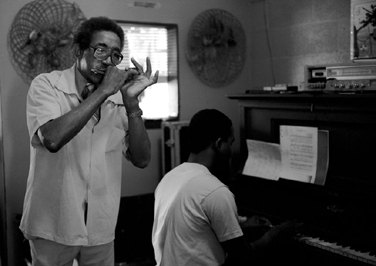
Walton is a bluesman in his own right. He took a harmonica out of
a drawer crammed with barber supplies and bent a few notes. He
didn't play long; he looked tired and frail.
He then turned on a cassette tape of him playing guitar with Big
Jack Johnson. Walton took out a straight razor and, striking a
leather strop, illustrated a source of rhythmic support as old as the
blues.
As he worked that strop, he danced, and the years seemed to fall
away.
Walton is proud of his musical heritage. He pointed with pride to a
photo of him playing for a group of Freedom Riders in the early
1960s. He opened a cabinet and pulled out a worn copy of Shake
'Em On Down: The Blues Of Wade Walton, an album he
recorded for Bluesville in 1958.
There was a time when Walton performed in many of the area's
juke joints. ''Didn't make no money, but we had a big time,'' he
said. ''We'd play, get a shot of whiskey, play some more, drink
some more, then go home before things got rough.''
These days, Walton performs for patrons only when the spirit
moves him -- and his spirit is moving mighty slow.
Walton's wife of 37 years is sick, and business isn't what it used to
be. Blues musicians don't come 'round much anymore. People
move on. Times change.
''These young kids, they don't know nothing about making music
with no washboards, combs or razor strops,'' he said, looking up
with sad eyes. ''And they don't care. All that's dying with the
people who know it, and that's a shame.''
In Wade Walton's yard sits a sign. ''House for Sale. Moving to St.
Louis.'' By year's end, Wade's Barber Shop will close forever.
''It's been nice,'' Walton said. ''But it's hell without money.'' Walton
extended his hand, and we headed to the parking lot.
Inside, Wade Walton sat in his barber chair, listening to his
recording of ''Leaving 4th Street,'' alone in the blues.
Sunday, Aug. 29: Ed Bumgardner and Chris English visit
Memphis, the city where cultures collided to create rock 'n' roll.
Published: August 22, 1999 in Journal
Now
 --
--