Goodbye,
Tomata du Plenty
David Xavier Harrigan, a.k.a. Tomata du Plenty,
lead
vocalist for the Screamers ('77-'81),
died in San
Francisco on Sunday, apparently from cancer.
He was
52. Born on Coney Island, Tomata was the
son of Irish
immigrants. He is survived by two sisters.
One of L.A.'s all-time biggest club bands,
the
Screamers were also its most mysterious.
They are
renowned as the original punk underground's
most
popular band, who vanished into thin air
without ever
releasing a single record, who never officially
toured, and who were so far ahead of their
time in
doing away with electric guitars in aggressive
rock
that they were called "techno-punk" by
local scene
scribe Kristine McKenna as early as February
'78.
Style and theater were also so much a part
of the
Screamers that nobody ever called them
out for being a
punk band with a full-time stylist. Later
on, under the
direction of Austrian filmmaker Rene Daalder,
the band
made a series of video clips and short
promotional
films nearly two years before MTV went
on the air.
Gary Panter's screaming, hair-raising
skull caricature of
Tomata has become one of the few recognizable
“official unofficial” emblems of the great
L.A.
underground rock band rebirth of the late
'70s.
No one with any management or business
skills
understood the Screamers or their lo-fi
psycho-Kraftwerk-meets-"The Night Porter"
as
performance art. Yet the band (one ARP
Odyssey synth,
one Fender Rhodes with fuzzbox, and one
minimal
drumkit plus Tomata) was still regularly
selling out
multiple consecutive nights at the Whisky
and the Roxy, two
shows a night, with their meticulously
polished
productions. Any unsigned band able to
rack up ticket
sales even half that amount today would
stir up a
major knock-down bloodied bidding war
among several
multi-national mega corporations.
Before moving to L.A. in early ‘77 Tomata
was a
beneficiary of Seattle’s “one-percent-for-the-arts”
policy at a time when there were more
than a dozen
funded live theaters in the city. Mostly
featuring
farcical musical comedies, these brought
out droves of
actors, designers, costumers, and performers
like
Tomata who were enticed to artist-friendly
Seattle
looking for low-wage work in the arts.
Tomata was a big hit on the thriving Seattle
off-theater circuit of the early 70’s
as a member of
Ze Whiz Kidz, a lip-sync troupe he originally
formed
with Gorilla Rose (RIP Michael Farris)
in ‘69. After
opening for Alice Cooper at the Paramount
in ‘72 with
a '50s-theme musical called “Puttin’ Out
In
Dreamsville” the vitality around Ze Whiz
Kidz
godfathered major rebirths of local scenes
in modern dance, performance
art, punk and the gay underground in Seattle.
Ze Kidz
staged nearly 100 mini-musical/revues
with a cast
whose stage names included Satin Sheets,
CoCo Ritz,
Daily Flo, Benny Whiplash, Michael Hautepants
(costume
designer Michael Murphy), Leah Vigeah
and real females
Louise Lovely (Di Linge) and Cha Cha Samoa
(Cha
Davis).
After bailing on Ze Kidz circa ‘74 Tomata
formed the
Tupperwares, an all-drag vocal trio with
Melba Toast
who later reinvented herself as Tommy
Gear (the
utterly enigmatic musician-writer who
wrote most of
the Screamers’ classic songs and then
seemed to
disappear) and Rio de Janeiro (David Gulbransen).
Frequently billed together on what came
to be known as
“TMT” shows, three Seattle bands--the
Tupperwares,
the Meyce and the Telepaths--basically
midwifed
Seattle’s version of the late '70s punk-new
wave
scene.
There was also a brief period in New York
with Gorilla
Rose and Fayette Hauser who performed
comedy at CBGB’s
with the Stilettos (featuring a pre-Blondie
Debbie
Harry) and the Ramones as opening acts.
After moving
to L.A. in early ‘77 the Tupperwares quickly
changed
their name to the Screamers after meeting
keyboardist
David Brown and transplanted Oklahoman
multi-media
artist and musician KK Barrett.
After the final break-up of the Screamers
in '81,
Tomata embarked on a new career as a painter,
and
after his first show at the Zero One Gallery
in '83,
he gradually evolved into a revered folk
artist who
worked the storefront gallery circuit
in Seattle,
L.A., Miami, New Orleans and San Francisco.
(He always
said he'd sooner sell 100 of his trademark
instant
paintings of his favorite artists and
other plain
folks at $25 each rather than one at $25,000.)
"With style, grace and humor," Tomata once
said,
"everybody must be made to feel important
sometime..."
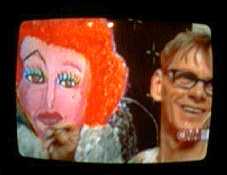
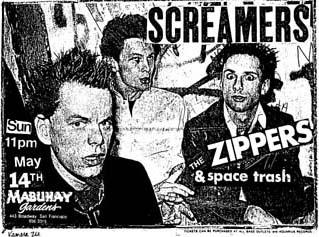
 -- The Screamers