Time, which Tito Puente
could make throb, pulsate,
swivel, shake and finally,
in the pounding rhythms of
mambo, cross over from El
Barrio in Harlem to the
Palladium to the airwaves of
America, caught up with the
legendary band leader and
percussionist late Wednesday
night, when he died at the age of
77.
He suffered complications after
open heart surgery at New York
University Medical Center, his
manager, Eddie Rodriguez, said.
The man popularly known as El
Rey, The King, who put mambo
on the map -- and who came to
be nearly as much a symbol of
New York City as Yankee
Stadium -- had been scheduled
to perform at a benefit
Wednesday evening at Christie's
Auction House.
When it became apparent to Mr.
Puente, who had become ill
while performing in San Juan
with the Puerto Rican
Symphony last week, that he
would be unable to go on, he
gave the order that his band be
there.
Why was it so important for Mr.
Puente, with his five Grammys
and 118 records and CD's, that
one little show go on?
"Tito was always a band leader,
the last of the real, true band
leaders, in the line of Duke Ellington and Count Basie," said Mr. Rodriguez,
who had spoken to Mr. Puente Monday before he entered the hospital.
"He felt responsible. He said, 'Keep the boys working.' That's what he
always said, 'Keep the boys working. Because I want to have my band
when I get out; I want it to be tight.' "
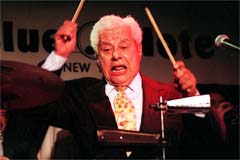
The most important Latin musician of the last half century and a key figure
in the fusion of Latin music with jazz, Mr. Puente, with his distinctive
cherubic mug, was an ebullient and wild performer who often clowned and
laughed as he whapped away on his timbales.
"What else have I got to sell?" he said a few months ago when asked
about this style. "I'm not Ricky Martin, to wave my hips around and show
my belly button. I don't have a girl in front of the band singing. I need
the
people to see I'm having a good time."
Known to the youngest of his fans as the man who wrote Carlos Santana's
hit "Oye Como Va," or perhaps from the 1992 movie "The Mambo Kings,"
in which he played himself, Mr. Puente had a career that spanned five
decades.
There were few jazz stars from the bebop era and beyond who did not find
him a compatible playing companion, and he was a staple of the old Salsa
Meets Jazz series at the Village Gate nightclub in Manhattan.
While many jazz groups added jazz sounds to Latin rhythms, Mr. Puente
liked to add a Latin rhythm section to a straight jazz arrangement. A fine
showman, he was not beyond gimmicks like recording Dave Brubeck's
"Take Five" in four-four time. He was also tireless; even in recent years
he
worked 200 to 300 performances a year.
But it was Mr. Puente's impact at the beginning of his career, bringing
Latin music to a new audience at the Palladium on Broadway at 53rd
Street, that made many grow nostalgic and teary at the news of his death
yesterday.
"He gave us all a life," said Robert Farris Thompson, a professor at Yale
University, where Mr. Puente had been awarded a Chubb Fellowship this
year. "And by us I mean not only Puerto Ricans, but mainland blacks, huge
numbers of Italians and Jews. We all loved him. There were guys my age
who were envious they weren't at the Moulin Rouge in the days of
Toulouse-Lautrec; who weren't at Minton's in the days of the birth of bop.
I was secure in the knowledge that I had been there on the birth of New
York mambo."
A musician who often said that he was "born in rhythm," Ernest Anthony
Puente was born on April 20, 1923, at Harlem Hospital and grew up on
110th Steet, off Madison, in the neighborhood then known as Spanish
Harlem, or the Barrio.
Both his parents were immigrants from Puerto Rico; his father worked in
a
razor blade factory; there was a younger sister and a younger brother.
Life
was not easy: Tito's father, Mr. Puente said in an interview in The New
York Times last April, was a gambler. His brother died at 4 in a fall from
the fire escape.
The young Tito was a drummer from the time he could remember,
drumming so loudly and so often, on the kitchen table, with pots and pans,
that the neighbors beseeched his mother to get her son music lessons. She
did, though to get the 25 cents a lesson she needed she had to go through
her husband's pockets for money when he was asleep.
Tito studied piano, then drums, then timbales -- a rack-mounted setup of
drums, cowbell, woodblock and other percussion instruments, which
provide crisp upper-register rhythms for Latin bands. He also toyed with
the idea of becoming a dancer, performing in the neighborhood with his
sister, Anna. The girls, Mr. Puente admitted in an interview in the autumn
of his years, were "nuts" about him.
But the music took precedence. Tito's big break came in the 40's, when
the
United Stated entered World War II. The drummer from the Machito
Orchestra, one of the first bands to fuse jazz and Latin music, was drafted,
and Tito took his place. A few years later, Tito dropped out of Central
Commercial High in Manhattan; the band, he would say years later, would
provide schooling.
Mr. Puente served in the Navy during World War II. His was not an
uneventful war; he served in nine battles, later receiving a presidential
commendation.
He also suffered a personal loss: his sister died.
His music education, however, continued. Mr. Puente met the jazz
trumpeter Charlie Spivak on the aircraft carrier Santee, and Mr. Spivak
taught him jazz arranging.
After the war Mr. Puente studied at the Juilliard School of Music under
the
G.I. Bill. But the school's emphasis on classical music made him restless.
In 1948 he started his own band, the Piccadilly Boys. Later, saying he
did
not want a band whose name could be confused with something on the
menu (picadillo is a meat and potato hash), he changed the name to the
Tito Puente Orchestra.
His early distinctive touch, putting percussion in front, happened by
necessity.
"The pretty boys were always in front, the percussion always in the back,"
Mr. Puente said in an interview with The Toronto Star. "But the frontmen
needed to get their rhythm cues from the percussion, and someone
suggested putting the rhythm in front instead. Now everyone does it."
Mr. Puente's first hit, "Abaniquito," came one year later. By the early
50's
the band had become the Tito Puente Orchestra and was packing them in
at New York's Palladium. Mambo was king, and Tito Puente was king of
mambo, recording dance favorites like "Barbarabatiri," "El Rey del Timbal"
and "Mambo Gallego." In the late 50's, Mr. Puente was fusing cha-cha --
the hot Latin cross-over dance of the Catskills -- with big band
compositions. The people who heard Mr. Puente play the Palladium still
get excited when they recall his sound.
"He was a genius, okay? The man who made you get up out of your chair
no matter who you were and dance," said Cuban Pete Aguilar, who knew
Mr. Puente when he was a boy, drumming in the basement in El Barrio
and who would years later be the choreographer for "The Mambo Kings."
"There was a rivalry between him and another orchestra leader, Tito
Rodriguez, and when the two of them got together to outdo each other,
when they got up and played their hearts out, let's just say the world
knew
they were playing."
In the 60's Mr. Puente began to collaborate with other New York
musicians, including Celia Cruz, who would become the Queen of Latin
Music to his King, with the trombonist Buddy Morrow, with Woody
Herman. In 1963 he recorded "Oye Como Va," which 12 years later would
be a hit for Carlos Santana. In 1968, Mr. Puente had his own television
show, on Hispanic television, "The World of Tito Puente."
The 70's were a down time for Mr. Puente.
"It was kind of a boogaloo era, and there were some other nonmusical
fads, and he had to do things to keep up with the Jones that were not so
good for his records," said Johnny Rodriguez, Mr. Puente's longtime road
manager.
But in the 80's, and particularly in the 90's, he was coming back. He
recorded with the jazz musicians Phil Woods, George Shearing, James
Moody, Dave Valentin, Hilton Ruiz and Terry Gibbs; he and his band often
performed with symphony orchestras.
He also became a sort of symbol of the New York Puerto Rican identity,
marching prominently in Puerto Rican parades. In 1995 Mr. Puente opened
a popular 250-seat restaurant on City Island.
The Oscar Hijuelos novel "The Mambo Kings Play Songs of Love," which
became the film "The Mambo Kings," also offered sweet vindication.
In that story two Cuban brothers move to New York in the 50's and form
a
mambo band; Mr. Puente is portrayed as the King, the center of the
mambo universe.
"I never thought playing in those places, writing that music, experiencing
it
all, that there would be a movie of it," Mr. Puente said in The Times.
"It's a
place and time that has really been overlooked."
And on a more personal note: "I'm finally getting some due. It's too bad
it
happened at this stage in my life, but better now than never."
Mr. Puente's personal life, as befitting a big band leader, was not tame.
During the war, on leave, he married a longtime girlfriend, Mirta Sanchez.
In 1947 they had a son, Ronald. The marriage ended in divorce. Today
both live in New York.
In the 50's, Mr. Puente also had a longtime relationship with Ida Carlini,
a
dancer, now living in Miami, who says she met Mr. Puente at the
Palladium as a girl of 15. ("An Abby Lane type, gorgeous," one Palladium
regular recalls, still smitten many decades later.) Their son, Richard
Anthony Puente, was born in 1953. He became a musician.
There followed a 30-year relationship with Margaret Acencio, with whom
Mr. Puente had a son, Tito Puente Jr., a musician, and a daughter, Audrey
Puente, a weather forecaster at Channel 4. Ms. Acencio and Mr. Puente
were married, Mr. Puente told The Times, "four or five years" ago, with
their 28-year-old son and 30-year-old daughter serving as their parents'
best man and maid of honor. There was no honeymoon.
"I have not taken a vacation in my whole life," Mr. Puente said in that
talk
four months ago. "Let me ask you a question: Have you ever known a
musician to take a vacation? You know when you're on vacation? When
the phone don't ring."
Mr. Puente, in that conversation, was happy, his spirits high. He was
recording, he believed, his 119th record. He said he felt wonderful --
like a
12-year-old kid.
Asked in that conversation what the King might want as his obituary, he
couldn't be bothered to give it a serious thought.
Or maybe he did.
"Nuthin'," Mr. Puente said, in that perfectly paced, musician's rhythm.
Then, laughing, which he liked very much to do, "Or maybe put a pair of
timbales on my grave."
 -- Tito
Puente Discography
-- Tito
Puente Discography