All-Music
Guide
Born: Gordon Beneke in Fort
Worth, TX on Feb. 12, 1914
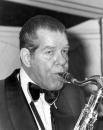
The name Tex Beneke is inevitably linked
to that of Glenn Miller, despite the fact that Beneke has
outlived Miller by 54 years. As
the most popular member of Miller's pre-World War II orchestra,
featured on songs such as "Chattanooga
Choo Choo" and "Don't Sit Under The Apple Tree," Beneke
became a major fixture in the popular
culture of the period, and following Miller's death in December
of 1944, and the reforming of the
Glenn Miller Orchestra after World War II, he accepted the offer to
lead the new band.
Beneke, however, had a lot to offer
the music world beyond his vocals on some fondly remembered hit
songs. He began playing the saxophone
at age nine, first with the alto and then with the tenor, and
played in local and regional bands
in Oklahoma and Texas during the early and middle 1930's. A gig
playing with a band led by Ben Young
brought him to Detroit, where he was spotted by Sam Donahue,
then a saxman in Gene Krupa's band--Krupa
was unable to hire Beneke but informed a friend of his in
New York of this promising new player.
The friend was Glenn Miller, who'd recently begun forming a
band of his own, and Beneke was
hired, joining the orchestra in the spring of 1938--it was with Miller's
band that Beneke picked up the nickname
"Tex."
The Miller orchestra struggled until
the summer of 1939, when an engagement at the Glen Island
Casino and a series of radio broadcasts
made it a national sensation. Beneke played and sang with the
orchestra, and became a star in
his own right. He stayed until 1942, when Miller broke up the band to
join the U.S. Army Air Force as
a band leader. Beneke was drafted into the navy and led a military
dance outfit at a base in Oklahoma.
After the end of the war, when a
new Glenn Miller Orchestra was formed, Beneke took on the
leadership, debuting in January
of 1946 at the Capitol Theater in New York City. The orchestra,
formed under the auspices of Miller's
widow and his estate, was intended to emulate the sounds of the
pre-war Miller band and his Army
Air Force band--this included the presence of 13 string players in
the 31 piece outfit, making it,
along with Harry James's orchestra, one of the few big bands to include
strings.
They were an immediate success, compiling
an enviable array of hits for five years. One gig, in
particular, stood out--in December
of 1947, a year after the near-collapse of the big-band business, at
the Hollywood Palladium, Tex Beneke
and the Glenn Miller Orchestra played to a record-breaking
crowd of 6, 750 dancers. Despite
this extraordinary popularity, however, Beneke wasn't entirely happy
with the restrictions placed by
the estate on the band's music--they were required to stick entirely to
the familiar reed-centered sound
that Glenn Miller had practically trademarked. Although a reed player
himself, Beneke saw other possibilities,
but was never allowed to experiment, despite his protests that
Miller himself had always been open
to the idea of experimentation, and had expressed his intention to
move away from his familiar reed
sound after the war, having gone as far with it as he felt he could.
Finally, at the end of 1950, Beneke
left the band and parted company also with Miller's estate. He later
organized his own band which, like
similar reconstituted big-bands led by '40s music icons such as
Harry James, managed to thrive amid
the rock 'n roll, folk-rock, psychedelia, disco, and punk eras, right
to the present day. More than 60
years after he became a professional musician, he still leads a
big-band doing the music that he
helped popularized two generations ago. And he still plays the sax and
sings. --
Bruce Eder, All Music Guide |
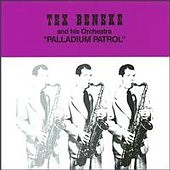
 -- Tex
Beneke discography
-- Tex
Beneke discography