The
press release by Steve Allen’s family
Television's Renaissance Man Steve
Allen Dies At 78.
Multi-talented television pioneer Steve Allen passed away suddenly
Monday night October 30th at the home of his youngest son, Bill,
in
Encino, California.
Mr. Allen was resting after a visit with four of his twelve grandchildren
when
he lost consciousness and died of an apparent heart attack.
Widely recognized for his renaissance talents as an author, composer,
musician, poet, playwright and performer, Allen was the creator
and first
host of NBC's Tonight Show. He also won Peabody and Emmy awards
for
his PBS series Meeting of Minds and starred in the memorable
motion
picture The Benny Goodman Story. The composer of over 8,500 songs,
including the popular standard This Could be the Start of Something
Big
and the Grammy award winning Gravy Waltz, Steve Allen was recognized
by the Guinness Book of World Records as the "most prolific composer
of
modern times."
Only the day before his death Mr. Allen had performed before a
sold out
audience at Victor Valley College, one of the scores of music
and comedy
concerts he continued to give around the country each year during
his
seventh decade of life.
Mr. Allen was also the author of more than 50
published books including
comedies and mysteries as well as more serious tomes on subjects
as
diverse as education, morality, China and the farm worker movement
of
Caesar Chavez. On the day of his death, Mr. Allen was working
on the
promotional plans for the December release of his 53rd book Steve
Allen's Private Joke File, and adding the final touches to his
manuscript
for his 54th book, Vulgarians at the Gate concerning the rising
tide of
violence and vulgarity in the popular media.
Steve Allen was married to television, film and stage actress
Jayne
Meadows for more than 46 years. Miss Meadows described Allen
as "my
best friend and my partner on stage and off for more than 48
years. He
was the most talented man I've ever known and the one true love
of my
life."
Steve Allen is survived by Miss Meadows, four sons, eleven grandchildren
and three great grand children.
|
TV
Host Steve Allen, Dies at 78
LOS ANGELES (AP) - Steve Allen, the droll
comic who pioneered late night television with
the original ``Tonight Show,'' composed
more than 4,000 songs and wrote
40 books, has
died at 78.
He died Monday night at the Encino home
of his son, Bill Allen, the son said Tuesday.
Allen also starred as the King of Swing
in the 1956 movie ``The Benny Goodman Story.'' He
appeared in Broadway shows, on soap operas,
wrote newspaper columns, commented on
wrestling broadcasts, made 40 record albums,
wrote plays and a television series that
featured guest appearances by Sigmund
Freud, Clarence Darrow and Aristotle.
His skill as an ad libber became apparent
in his early career as a disc jockey in Phoenix. He
once interrupted the playing of records
to announce: ``Sports fans, I have the final score
for you on the big game between Harvard
and William & Mary. It is: Harvard 14, William 12,
Mary 6.''
Allen's most enduring achievement came
with the introduction of ``The Tonight Show'' in
1953. The show began as ``Tonight'' on
the New York NBC station WNBT, then moved to
the network on Sept. 27, 1954.
Amid the formality of early TV, ``Tonight''
was a breath of fresh air. The show began with
Allen noodling at the piano, playing some
of his compositions and commenting wittily on
events of the day. He moved to a desk,
chatted with guests, taking part in sketches, doing
zany man-in-the street interviews.
``It was tremendous fun to sit there night
after night reading questions from the audience
and trying to think up funny answers to
them; reading angry letters to the editor;
introducing the greats of comedy, jazz,
Broadway and Hollywood; welcoming new comedians
like Shelley Berman, Jonathan Winters,
Mort Sahl and Don Adams,'' he once said.
Allen's popularity led NBC in 1956 to schedule
``The Steve Allen Show'' on Sunday evenings
opposite ``The Ed Sullivan Show'' on CBS.
A variation of ``Tonight,'' the primetime
show was notable for its ``Man in the Street
Interview'' featuring new comics Louis
Nye (``Hi-ho, Steverino''), Don Knotts, Tom Poston,
Pat Harrington and Bill Dana. The show
lasted through 1961, although the last year was on
ABC.
Allen cut back his ``Tonight' duties to
three nights a week when the primetime show
started. He left even that in 1956. He
was replaced for a season by Ernie Kovacs, then NBC
tried a new format in 1957, ``Tonight!
America after Dark.'' It failed, and ``Tonight''
resumed with Jack Paar, followed by Johnny
Carson in 1962.
Over the years, Allen maintained a busy
career, making appearances in movies and TV
series, often with his wife Jayne., Her
sister, the late Audrey Meadows, portrayed the
long-suffering Alice to Jackie Gleason's
Ralph Kramden on ``The Honeymooners.''
He wrote great quantities of songs, and
several were recorded by pop vocalists. His most
popular song was ``This May Be the Start
of Something Big.''
A self-styled advocate of ``radical middle-of-the-roadism,''
Allen often spoke out on
political matters such as capital punishment,
nuclear policy and freedom of expression. He
once considered running for Congress as
a Democrat, but decided against it.
Toward the end of his life, he spoke out
against the increase of sexual content on
television. In a speech last year, he
said tabloid television talk shows such as the ``Jenny
Jones'' show have ``taken television to
the garbage dump.''
``There are moral failures in the marketplace,''
he said.
Allen was proudest of his ``Meeting of
Minds'' series which appeared on PBS from 1976 to
1979. He moderated a panel of actors impersonating
historic figures such as Galileo, Emily
Dickinson, Cleopatra (played by Jayne
Meadows), Charles Darwin and Attila the Hun, who
explained their diverse philosophies.
When an interviewer asked Allen in 1985
how he managed to do so many creative things,
he replied:
``I never asked myself that question. It
would be like asking how my hair grows. The
mystery of creativity is just that: it
is a mystery, and particularly mysterious to me about
myself.''
Steve Allen came by his humor naturally;
both his parents, Billy Allen and Belle Montrose,
were vaudeville comedians. Their son was
born in New York City on Dec. 26, 1921, during a
brief respite from their travels. Steve
was 18 months old when his father died, and his
mother continued touring the circuits
as a single.
The boy grew up in other people's homes,
mostly with his mother's family in Chicago, the
Donahues. He remembered the place as ``a
rooming house with the smell of cabbage
cooking.''
Allen won a partial scholarship to study
journalism at Drake University, but severe asthma
caused him to transfer to Arizona State
Teachers College in 1942. After a few months he
dropped out to work as a disc jockey and
entertainer at radio station KOY in Phoenix.
Drafted in 1943, he was soon released because
of asthma. He returned to KOY, and married
his college sweetheart, Dorothy Goodman.
They had three sons, Steve Jr., David and Brian,
and divorced in 1952.
Allen moved to Los Angeles and began offering
his comedy and music on local radio.
A midnight show on KNX brought Allen a
small but enthusiastic audience and attracted
national attention in 1950 when it was
carried on the CBS network as a summer
replacement for ``Our Miss Brooks.'' The
networks were converting to television, and he
was invited to New York for ``The Steve
Allen Show,'' which appeared five evenings a week
on CBS.
In 1952, Allen was invited to a dinner
party at which he was seated next to the beautiful
actress Jayne Meadows. Uncharacteristically,
he was speechless.
At the end of the evening, she turned to
him and said, ``Mr. Allen, you're either the rudest
man I ever met or the shyest.'' His reddened
face indicated the latter. They began dating
and married in 1954.
Their only child, Bill, said that on Monday,
his father was visiting his home. ``He said he
was a little tired after dinner. He went
to relax, peacefully, and never reawakened,'' the
younger Allen said.
He added that his father had a ``long,
full and extraordinary life.'' |
Quotes
on Steve Allen
By The Associated Press,
Show business friends and colleagues talk
about Steve Allen:
``He was one of the sharpest guys off the
cuff. He never played dumb. He played many
characters, straight man and comic, and
he did each role perfectly. But the role he played
best was Steve Allen.'' - ``Tonight Show''
host Jay Leno.
``All of us who have hosted the 'Tonight
Show' format owe a debt of gratitude to Steve
Allen. He was a most creative innovator
and brilliant entertainer.'' - Former ``Tonight Show''
host Johnny Carson.
``He had a magnificent mind. His mind just
wouldn't stop. It was overflowing with a variety
of subjects. He had an extraordinary technique
of making you feel warm and communicated
with you. He was a kind, gentle and warm
man. I can't put into words the way I felt about
this man. I loved him.'' - Entertainer
Dick Clark.
``What was great about Steve is all of
America thought of him as their friend or neighbor.
He was talented in so many different ways,
he was a true triple threat kind of guy. Steve
Allen was an American original.'' - Pianist
Richard Williams, a frequent guest on Allen's
television shows.
``Quite an incredible man we have lost.
It was just quite a thing to watch him. He was
always doing something. He was such an
intelligent man and that's what made him so
prolific with writing. Lately, he's been
on a vent to lift up the morality of our business. He
was very upset about what happened on
certain radio and television shows. He was a very
concerned citizen about what was going
on in the world.'' - Entertainer Ed McMahon.
``I'm not sure they make men like Steve
Allen anymore. He worked to the last moment. He
was a legendary figure who had real depth.''
- Michael Levine, former publicist for Allen.
``He had one of the best comic minds in
the business. No matter what you were talking
about, he could make it funny.'' - Comedian
Rich Little.
``Rarely have I ever known a man more humble
and more decent. What made Steve truly
heroic was what he did in his final years,
so courageously championing a national cause to
restore a sense of decency to the industry
he so dearly loved and which has so clearly lost
its way.'' - Brent Bozell III, chairman
of the Parents Television Council, a nonprofit
organization to restore responsibility
to the entertainment industry.
``He was my best friend and my partner
on stage and off for more than 48 years. He was
the most talented man I've ever known
and the one true love of my life.'' - Wife Jayne
Meadows.
``Steve Allen was an enormous influence
on television. His early work is really the
foundation for what late-night shows have
become.'' - Talk show host David Letterman.
``If it wasn't for him there wouldn't be
any talk shows.'' - Comedian Milton Berle.
``His career has proved that he was one
of the great renaissance figures of today, whether
it's music, writing or talking. He was
helpful for anybody in any kind of cause. I can't believe
we are losing him.'' - Comedian Art Linkletter.
|
NY
TIMES
Steve
Allen, Comedian Who Pioneered Late-Night TV Talk Shows, Is Dead at 78
Steve Allen, the versatile entertainer who created
the "Tonight" show for NBC in 1953 and was widely
regarded as a founding father of the late-night talk show,
died on Monday at the home of his son Bill in Los Angeles.
He was 78 and lived in Los Angeles.
The cause was apparently a heart attack, his family said.
In more than 50 years in show business, Mr. Allen
demonstrated his talents in many areas. An accomplished
pianist who never learned to read music, he composed
more than 5,000 songs, some of them hits. Among them
were "This Could Be the Start of Something Big,"
"Impossible" and "Gravy Waltz." He wrote the lyrics
for some movie music, including ballads heard in
"Picnic," "Houseboat" and "On the Beach."
He also wrote more
than 50 books, all of them dictated
into a small tape recorder that he always carried. They
ranged from poetry and novels to social criticism,
music, foreign affairs and, of course, humor. A new book,
"Steve Allen's Private Joke File," is to be published in
December.
Mr. Allen was keenly interested in social justice
and wrote pamphlets on a variety of issues, including
the problems facing migrant workers, as well as capital
punishment and nuclear proliferation. (He was
opposed to both.) He once considered running for
Congress from California, calling his politics
"middle-of-the-road radicalism," which was his
way of describing mid- century liberalism.
He acted in several movies, among them
"The Benny
Goodman Story" (1955), in which he played
the title
role, and was a master of ceremonies or
a guest on many
television programs, including several
versions of "The Steve
Allen Show" as well as "I've Got a Secret"
and "What's My Line?"
But he was probably best known for the humor that
seemed to tumble effortlessly from his lips in
television appearances, accompanied by a
high-pitched giggle. Mr. Allen believed that everyone
had a "silly center" and that no one should try to
suppress it.
So when he was told that he had colon cancer in
1986, he said he would list his condition as critical:
"critical of nurses, critical of doctors, critical of the
food, critical of the prices." When the hospital listed
his condition as stable, Mr. Allen said, "You know
what the condition of the average stable is."
In his heyday on the "Tonight" show, from 1954 to
1956, Mr. Allen once delighted his fans by going out
on the street dressed as a New York City policeman,
hailing a taxi, hurling a huge salami into the back
seat and ordering the driver to "take this to Grand
Central Station." He read an assortment of things to
the studio audience, finding much humor in the
letters to the editor of The Daily News. He was
especially fond of letters with signatures like
"Disgusted, from the Bronx."
He loved practical jokes. On one occasion he put out
a record album of piano music called "The Discovery
of Buck Hammer." The cover featured a photograph
of a pianist whose talent was said to have been
discovered posthumously. Critics loved the album,
only to learn later that all the playing had been Mr.
Allen's.
He would invite his studio audience to suggest song
titles and then devise a lyric instantly. Once
someone shouted the name of the best seller of the
day "Dr. Zhivago," which led Mr. Allen to sit down at
the piano and sing to the tune of "Chicago":
Zhivago! Zhivago!
Whenever I'm sick
Zhivago! Zhivago!
You cure me real quick.
Stephen Valentine Patrick William Allen was born on
Dec. 26, 1921, in New York to parents who were part
of a vaudeville team. His father, Carroll, worked
under the name Billy Allen and was straight man to
his mother, the former Isabelle Donohue, whose
stage name was Belle Montrose. His father died
when he was 18 months old.
Mr. Allen spent his formative years in Chicago, living
with his mother's family, whom he later described as
"sarcastic, volatile, sometimes disparaging, but very,
very funny." In 1941 he briefly attended Drake
University in Des Moines on a journalism scholarship
and then Arizona State Teachers College. He was
drafted into the Army but was discharged after five
months because of recurring attacks of asthma.
After his discharge, he started working in radio, first
in Phoenix, then in Los Angeles. In 1947 he was
hired by KNX, the CBS affiliate in Los Angeles, to be
a disc jockey. Fans were greatly attracted to his
chatter, and he soon spent more time talking than
he did playing records. As many as a thousand
people would visit his studio broadcast each
Saturday night, and Mr. Allen would interview them
as well as celebrity guests.
He made a bet with Frankie Laine, the singer, that
he could write 50 songs a day for a week. He
remained in the window of a Hollywood music store
and did it, winning $1,000 from Mr. Laine. One of the
songs, "Let's Go to Church Next Sunday," was
recorded by both Perry Como and Margaret Whiting.
CBS invited him to Manhattan and gave him his own
half-hour television show from 1950 to 1952. He
moved to NBC in 1953 as host of "Tonight." The
predecessor of what would become Johnny Carson's
long-running "Tonight," it began as a local program
on WNBT, which was then the New York outlet for
NBC. It moved to the network 15 months later.
In the beginning the show's regulars included Gene
Rayburn, the announcer, and Skitch Henderson, the
orchestra leader. Somewhat later, Mr. Allen
discovered and promoted the singing talents of
Steve Lawrence, Eydie Gorme and Andy Williams.
There were many stunts; he had his hair cut on one
show, sold hot dogs on another and tried out
weight-reducing equipment on still another. He
frequently took his microphone into the audience.
Mr. Allen cut back his "Tonight" schedule in the
summer of 1956 to begin "The Steve Allen Show,"
which NBC offered as a prime- time Sunday night
competitor to "The Ed Sullivan Show" on CBS and
"Maverick" on ABC, and left late-night television for
good in January 1957.
Among the comedians whose careers flourished on
"The Steve Allen Show" were Don Knotts, who played
a terminally nervous individual named Mr. Morrison;
Bill Dana, who appeared as a Latin astronaut named
José Jiménez; Pat Harrington, who was Guido
Panzini, an Italian golfer; Tom Poston, the very
forgetful man; and Louis Nye, who played the always
effete advertising executive Gordon Hathaway and
always called Mr. Allen "Steverino." The show ran
through the 1959-60 season and was in syndication
throughout the 1960's.
"The Steve Allen Comedy Hour," with some of the
"Tonight" regulars, ran on CBS during the summer of
1967, and Mr. Allen was host of a similar variety
show on NBC in 1980 and 1981.
Besides performing, Mr. Allen generated many ideas
for programs. One, "Meeting of the Minds," offered
imagined conversations between figures of the past,
among them Emily Dickinson, Galileo, Charles
Darwin and Attila the Hun. Mr. Allen acted as
moderator. The program was seen on public
television in the 1970's.
He also wrote the music and lyrics for "Sophie," a
Broadway musical based on the life of Sophie
Tucker, which ran for only eight performances in
1963; the book, music and lyrics for "Seymour Glick
Is Alive but Sick," a revue produced in 1982; and
music and lyrics for songs in "Alice in Wonderland," a
musical produced on CBS in 1985.
Mr. Allen never stopped performing, making personal
appearances and doing radio broadcasts. In January
1995 he played the title role in a production of "The
Mikado" by the New York Gilbert and Sullivan
Players. In recent years he began speaking out
against what he saw as a rising tide of smut on
television, condemning shows that he felt had
"taken television to the garbage dump." At the time
of his death he was completing a book on the
subject, "Vulgarians at the Gate."
Mr. Allen's first marriage, to Dorothy Goodman,
ended in divorce. In 1954 he married Jayne
Meadows, the actress and sister of Audrey Meadows.
In addition to their son, Bill, he is survived by 3
sons from his first marriage, Stephen Jr., Brian and
David; 11 grandchildren; and 3 great-grandchildren.
|
|


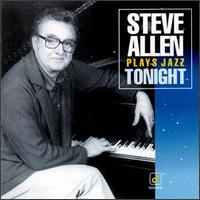
 -- Steve Allen discography