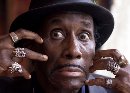
R&B Wild Man Screamin' Jay Hawkins Dies
Screamin' Jay Hawkins, the prototypcial shock-rocker whose
onstage antics included popping out of a coffin, died Saturday near Paris. He was
70.
The shrieking R&B wild man was hospitalized at
Ambroise Pave clinic in Neuilly-sur-Seine after developing an aneurysm following intestine
surgery, and he subsequently suffered multiple organ failure, Associated Press
reports.
Before there was KISS, Alice Cooper or Marilyn Manson,
there was Screamin' Jay with his voodoo-inspired songs ("I Put a Spell on You,"
"[She Put the] Wamee [on Me]" ), flaming skull sidekick (known as Henry),
outrageous gold lamé and leopardskin get-ups, the infamous coffin routine and enough
stage pyrotechnics (that would often leaved him scorched).
Born Jalacy Hawkins on July 18, 1929, in Cleveland, the
musician's early years were the stuff of myth--which he gladly adopted as truth. He was,
he claimed, taken from an orphanage at age 1 and raised by a Blackfoot tribe. He joined
the army at 14, spending his spare time boxing before pursuing his musical talents full
time.
As the story goes, Hawkins got his nickname from a
scotch-guzzling fat lady in a bar, who kept telling him to "Scream, baby,
scream!" Once asked about the otherwordly vocals on his tracks, he replied, "I
don't sing them. I destroy them."
Hawkins was actually a wannabe opera singer, initially
styling himself after Paul Robeson and Maria Lanza. But when he couldn't crack the
classical world, he parlayed his piano and sax skills into a gig with jazz vet Tiny Grimes
in 1951. Backed by Grimes and his Rockin' Highlanders (in a preview of things to come, the
group took to wearing kilts on stage), Hawkins recorded his first single, "Why Did
You Waste My Time," a year later.
His biggest hit was the immortal "I Put a Spell on
You," which he recorded on the Okeh label in 1956 (and was later the breakthrough
single for Creedence Clearwater Revival). His other notable tunes include "Alligator
Wine," "Feast of the Mau Mau," "I Hear Voices" and
"Constipation Blues."
In his latter years he was viewed more as a novelty or
cult act than as a serious artist, and he spent much of his time abroad, eventually
settling in France. He also tried his hand at acting, appearing in Jim Jarmusch's Mystery
Train (1989) and A Rage in Harlem (1991). |
The
Lasting Echo of Screamin' Jay Hawkins
By David Segal
Washington Post Staff Writer
Back in 1956, when Screamin' Jay Hawkins had an eight-show-a-week
gig at an Atlantic City bar, he dreamed up a nifty way to draw a crowd: He
would sneak into ladies' rooms up and down the Boardwalk and scrawl
red-lipsticked ads for his show on bathroom mirrors. It caught a few eyes.
So did the stage act he later developed, which featured Hawkins rising
from a flaming, zebra-striped coffin, his head wrapped in a white turban,
his hands clutching a cigarette-smoking skull stick, which he'd christened
Henry.
Hokey? Of course. Riveting? Every time.
Hawkins, who died on Saturday in France at age 70, will not be
remembered for a lifetime of chart-topping singles or platinum albums. He
never really cracked the Billboard charts, not even with his one certifiable
claim to rock fame, his hilarious and haunting 1956 song "I Put a Spell on
You."
But he was a master at commanding the undivided attention of an
audience, and devised an onstage ghoul shtick that many better-selling acts
shamelessly imitate. Hawkins's most startling gift was his voice, a hellbent
howl that producers wisely drenched in reverb, giving the impression that
he was singing in a swamp and scaring all the animals. But his most
enduring legacy is the macabre-tinged showmanship of Ozzy Osbourne,
Alice Cooper and most recently Marilyn Manson, who covered "Spell" in
his 1995 shock-rocking "Smells Like Children" album. The key difference
is that Manson likes to pretend he's dead serious--and a genuine menace
to civilization--whereas Hawkins never tried to hide the giggles behind his
voodoo mask.
Not that Hawkins didn't alarm a few onlookers. For a while he liked to
perform with a bone through his nose, white paint on his face, a loincloth
around his waist, a spear and shield in his hands, and his hair brushed
straight up. That infuriated groups like the NAACP, which worried that his
act would reflect badly on African Americans. It all seems perfectly tepid
compared with today's rap stars, but some black magazines and
newspapers were appalled enough to ignore Hawkins.
That's only one reason that he lived through so many lean years during his
five-decade career. Born Jalacy Hawkins in Cleveland--he long maintained
that he was conceived in Washington--he spent much of his childhood in
orphanages. He was a semi-noteworthy middleweight boxer, but he soon
traded the boxing gloves for tenor sax and piano. He enlisted in the Air
Force in 1944 and entertained troops in the United States, England and
Japan.
When he left the armed services, he plunged into the then-thriving R&B
circuit, serving briefly in Fats Domino's band. (Hawkins's leopard skin suit
upstaged the boss and he was fired.) A few years later, a particularly
humiliating kiss-off by a fed-up girlfriend--she waved goodbye right while
he was playing with his band--inspired Hawkins to a little bit of creative
revenge.
"The next day I was sitting at the piano," he told The Washington Post in
1990, "wondering why she left me--I didn't want to admit I was
wrong--and I was tapping on the piano and I said, 'This is so stupid, to
walk away and leave me like that without giving me a chance to explain. . .
. She didn't know she's was messing with a witch doctor. . . . I'll put a spell
on her.' "
Hawkins's original version of the song went nowhere, but an enterprising
producer later rerecorded it, this time plying Hawkins and his band with
liquor in a raucous all-nighter. Hawkins got so drunk that 10 days later he
was startled when a messenger showed up with the single in hand. He had
no memory of the session.
The song is a minor masterpiece of pent-up tension, with little more than an
echoey piano and drums pounding in marching time toward an emotional
peak, as Hawkins yelps and threatens his ex-lover with a hex. The
performance is so unhinged that it even intimidated Hawkins, who said that
for 30 years he would sing the song live only after he hit the bottle.
The tune caught the ear of Nina Simone as well as Creedence Clearwater
Revival, just two of the acts that eventually recorded it. "Spell" loomed so
large in Hawkins's life that he was considered a one-song novelty act for
years, though he recorded plenty of other memorable numbers, including
"Alligator Wine" and "Little Demon."
But Hawkins was a natural and incorrigible ham and never obsessed much
about being taken seriously. Later in his life, there were brief resuscitations
courtesy of admirers--including the Rolling Stones, who asked Hawkins to
open for the band at Madison Square Garden in 1980. He also turned up
in a pair of films by Jim Jarmusch, "Stranger Than Paradise" and "Mystery
Train." In the '90s, Hawkins signed up with Demon Records and his "Heart
Attack and Vine" was featured in a Levi's commercial.
"Scream, baby, scream!" urged a drunken fan in a West Virginia bar in
1950, handing Hawkins the name he would carry for half a century and a
piece of advice that he never forgot.
© Copyright 2000 The Washington Post Company |
NY TIMES
Screamin' Jay Hawkins, 70, Rock's Wild Man
By
JON PARELES
Screamin' Jay Hawkins, who howled, whooped, gurgled and
shrieked his way through some of the most unhinged performances
in
rock history, died on Saturday in Neuilly-sur-Seine, a suburb of Paris.
He was
70 and lived near Paris.
The
cause was multiple organ failure following emergency surgery to treat
an
aneurysm, The Associated Press reported.
Mr.
Hawkins's 1956 hit, "I Put a Spell on You," defined a career built on
vocal
dementia, imagery lifted from voodoo folklore and B-movies, an
anarchic sense of humor and a stage show that raised the stakes on rock
'n'
roll theatricality. He took stereotypes of black savagery -- cannibals,
witch
doctors -- and mocked them with gleeful hyperbole. He would
arrive
on stage in a flaming coffin, wearing a black satin cape and,
sometimes, a bone in his nose, clutching a cane topped by a flaming,
cigarette-smoking skull named Henry. Snakes, tarantulas, shrunken
heads
and a crawling hand were also part of the act.
Whether he was singing his own songs or tearing into a sentimental
standard, Mr. Hawkins might at any moment jettison the melody for
shouts, moans or bursts of gibberish. "I don't sing them," he once said of
his
songs. "I destroy them."
He
was part of a tradition of rhythm-and-blues wild men that also
included Little Richard, and he was the precursor of rock showmen like
Jimi
Hendrix, Alice Cooper, Marilyn Manson and White Zombie.
Jalacy J. Hawkins was born on July 18, 1929, in Cleveland. His mother
had
seven children, each with a different father. He grew up in foster
homes.
"My mama said that out of all the men, my father was the hardest, the
meanest and the rottenest," he once said. "She would look at me and say,
'You're no good, you're gonna be just like your father.' I said: 'I'm gonna
fool
you. I'm gonna make something of myself.' "
He
began playing piano as a child and studied opera at the Ohio
Conservatory of Music. He was also a boxer and won a Golden Gloves
championship in 1943. When he returned to the United States after
military service, he wanted a career in opera. "I had hopes that someday
I
could become a black Mario Lanza or Enrico Caruso," he said.
But
to make a living he turned to the jazz and rhythm-and-blues circuit,
stretching his voice to imitate the sounds of honking tenor saxophonists.
He
began working for the jazz guitarist Tiny Grimes as valet and pianist,
and in
1951 he made his first single, "Why Did You Waste My Time,"
backed
by Mr. Grimes and his Rockin' Highlanders.
He
recorded for Timely and Wing Records, and joined Fats Domino's
road
band for a short time. In 1956 he planned to record a plaintive
ballad, "I Put a Spell on You" for Okeh Records. The producer, Mr.
Hawkins said, "bought gin and whiskey, a lot of booze, baby, and got us
all
drunk in the recording studio."
The
unruly, unforgettable results became a hit that was banned by many
radio
stations for its moans and grunts. Reveling in his untamed image, he
followed up with songs like "Feast of the Mau-Mau" and "Alligator
Wine."
The
disc jockey and promoter Allan Freed got the idea of bringing Mr.
Hawkins onstage in a coffin for a Cleveland concert. Mr. Hawkins once
said
Freed paid him $5,000 to persuade him to go through with it,
although other accounts say the bonus was $300. It thrilled the crowd,
and
the coffin became a regular part of the show. On one multiple bill the
Drifters locked Mr. Hawkins inside the coffin; he wriggled until it fell off
its
stand.
Mr.
Hawkins grew tired of having to play what he called "that weird,
voodoo, black, screaming Vincent Price image," and in the early 1960's
he
moved to Hawaii, where he bought a bar and tried to settle down. But
by the
late 60's Mr. Hawkins had resumed performing, playing up his
bogeyman image even as he protested that he still hoped to sing opera.
Mr.
Hawkins toured regularly in the United States and Europe. He
opened
the 1980 concert by the Rolling Stones at Madison Square
Garden, and Keith Richards produced a remake of "I Put a Spell on
You." Movie appearances periodically stoked Mr. Hawkins's career. He
was
seen in "American Hot Wax" in 1978, "Mystery Train" in 1989 and
in
"A Rage in Harlem" in 1991. In 1998 he received the Pioneer Award
from
the Rhythm-and-Blues Foundation.
Unlike many early rock performers, Mr. Hawkins owned the copyright
to his
songs, including "I Put a Spell on You," which brought royalties
when
it was recorded by performers including Nina Simone and
Creedence Clearwater Revival. In 1997 "I Put a Spell on You" was
sampled by the Notorious B.I.G. for "Kick in the Door" on his
million-selling album "Life After Death."
"I wrote in my will to cremate me," Mr. Hawkins said. "Fly over the
ocean
and scatter the dust, so I can be little particles in everybody's eyes,
drive
everybody crazy the rest of their lives." |
|


 -- Screamin'
Jay discography
-- Screamin'
Jay discography