|
Calypsonian who found religion after
a life of sex and drugs
Peter
Mason
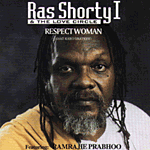
Few life conversions have been more
spectacular than that of the Trinidadian
calypsonian and father of soca music,
Ras Shorty I, who has died from bone
cancer aged 58.
As the notoriously free- living "Lord
Shorty", he was the classic Port of Spain
"saga boy" in the 1960s and early 70s,
taking part in what he later described as
an "orgy of the flesh"; as the self-styled
"Love Man", he had a prodigious appetite
for women, drink and drugs.
Then, in the late 1970s, he found religion,
renounced worldly pleasures and moved
deep into the remote Piparo forest in
southern Trinidad, 50 miles from Port of
Spain. There he built a house, changed
his name to Ras Shorty I, grew
dreadlocks and lived quietly for the rest of
his life with his wife, Claudette, and their
14 children.
The constant thread in his life was music.
In Piparo, he proved to be a great
songwriter, producing new, avowedly
spiritual, tunes that were as popular with
the Trinidadian public as his previous, far
more frivolous, output.
His greatest legacy, however, was as the
force behind soca music, which, with its
up-tempo and more funky outlook, brought
calypso music into the modern era.
Though of African descent, he also played
a significant role in bringing the sounds of
Trinidad's Indian community into the
island's musical mainstream. A cover
version of his song, Om Shanti, became a
major hit in India.
Born Garfield Blackman in Lengua,
Trinidad, Shorty - so named in ironic
reference to his 6ft 4in frame - began
singing at the age of seven, and made his
breakthrough in 1963 with the song Cloak
And Dagger. He quickly became known
as the most outrageous of calypsonians,
in a profession renowned for carousing
lifestyles. Many of his lively and hugely
popular compositions, such as Lesson In
Love, were appropriately risqué and
sex-orientated, and in 1973 he was
charged with obscenity, a complaint only
dropped after the inter vention of the
Trinidadian prime minister, Eric Williams.
Shorty's most important mark was made
with the 1974 album Endless Vibrations,
which was the first to use the new soca
rhythm. Like his Lord Shorty persona, his
music was bold, loud, sensuous and
larger than life. It was much copied, and
has become part of the bedrock of
calypso.
By 1977, however, Shorty had became
disenchanted with the image he had
created, and when Maestro, a close
calypsonian friend and composer, was
killed in a car crash, he underwent a
dramatic change of direction, swapping
his fancy clothes for togas and sandals,
and retreating to the forest.
In Piparo, after a period of
Rastafarian-inspired reflection and
establishing a new-found faith in
Christianity, he gathered together some of
his talented children to form his own
musical group, the Love Circle, and
devoted himself to writing songs about
spiritual matters and the dangers of
hedonism.
Though he sometimes complained that "a
lot of people can't accept the fact that I
am no longer Lord Shorty", the new
message he gave out was warmly
received by most Trinidadians - as well as
by those further afield, who came to hear
his songs through the burgeoning 1980s
world-music scene. In 1977, his anti-drug
song, Watch Out Children - which warns
against "a fella called Lucifer with a bag of
white powder, he don't want to powder
your face but bring shame and disgrace to
the human race" - was an international
success translated into 10 languages.
Latterly, in a song called Latrine Singers,
he lambasted Trinidad's new generation of
calypsonians for their obsession with
sexually-fixated lyrics. Although the song
caused heated debate in Trinidad - and
earned Shorty some insults from younger
singers - it did nothing to damage the
respect in which he was almost
universally held.
Shorty also continued his mission to
promote the "Indianisation of calypso",
writing a number of songs that presaged
the current boom in Trinidad of
Indian-influenced "chutney soca". Last
month, he and his band released God's
Calypsonian, containing reworkings of
"Lord Shorty" hits that he had no
objection to, plus more recent numbers.
Garfield Blackman (Ras Shorty I),
calypsonian, born October 6 1941; died
July 12 2000 |