Gospel
Singer 'Pops' Staples Dies
By HERBERT G. McCANN, Associated Press Writer
CHICAGO (AP) - Roebuck "Pops'' Staples, patriarch of the gospel and
rhythm-and-blues group the Staple Singers, died Tuesday. He was 84.
Staples had suffered a concussion recently in a fall near his home in suburban Dolton.
He and his group gained fame in the 1960s by singing music that urged social and
religious change. He was known for both his songwriting and his guitar playing, in which
he fused gospel with the blues.
Born to a poor Winona, Miss., family on Dec. 28, 1915, Staples dropped out of school
after the eighth grade to pick cotton.
Staples sang with a gospel group, the Golden Trumpets, before moving with his wife,
Oceala, to Chicago in 1936, where he performed with the Trumpet Jubilees.
Staples said his earliest exposure to music came in the church. It wasn't until he was
in his teens that he heard the blues. He listed Bessie Smith, Ma Rainey and Blind Lemon
Jefferson among his favorites.
Staples formed the group bearing his name in 1948. Originally composed of son Pervis
and daughters Mavis and Cleotha, the Staple Singers began as a gospel group that performed
in Chicago churches, backed by his minimalist playing. Mavis, then 7 years old, sang bass
in the group.
Their first recordings came in the 1950s.
It was during the 1960s that the Staple Singers switched to protest, inspirational and
contemporary music, reflecting the civil rights and anti-war protests of the time.
"But we just kept on singing and praying, and we let our music carry the
message,'' Staples said afterward. ``When people realized that our music still had the
message of love, our audience grew - old people came back, and new people kept coming.''
The Staple Singers gained a huge audience with their first No. 1 hit "I'll Take
You There'' in 1972 and followed with top 40 hits "Respect Yourself,'' "Heavy
Makes You Happy,'' and "If You're Ready (Come Go With Me).''
In 1975 on Curtis Mayfield's
Custom label, the Staple Singers released "Let's Do It Again,'' the title track of
the film starring Bill Cosby and Sidney Poitier.
While the Staple Singers enjoyed success in the 1980s, "Pops'' Staples began a
solo career and tried his hand at acting.
His 1992 "Peace to the Neighborhood'' garnered a Grammy nomination, and in 1994 he
released "Father, Father,'' winning a Grammy.
Staples in survived by his children, Cleotha, Pervis, Yvonne - who replaced Pervis in
the group - and Mavis. His wife, Oceola, preceded him in death. |
'POPS' STAPLES, 85; TRIED
TO IMPROVE WORLD WITH MUSIC
By James Janega
Chicago Tribune Staff Writer
December 20, 2000
Gospel performer Roebuck "Pops" Staples, 85,
spent a lifetime infusing pop music with social messages, convinced he could improve the
world through the songs he sang.
If the world didn't change, the music industry at least stood up and took notice.
The patriarch of the Staple Singers, whose songs "I'll Take You There" and
"Respect Yourself" topped charts a decade after the group brought social
concerns of the 1960s to a wider audience, died of a heart attack Tuesday, Dec. 19, in his
Dolton home.
"The Staple Singers were one of the most influential gospel groups in pop
music," said Anthony Heilbut, author of "The Gospel Sound: Good News and Bad
Times." "You could hear echoes of the Staples in everyone from Aretha Franklin
to Prince to Bob Dylan."
Mr. Staples' voice--light, conversational and easy-going--said more in a softly
insinuated line than a choir full of shouting singers, while his lyrics stayed focused on
social and spiritual matters, as Mr. Staples reportedly did himself.
"When Dr. King started preaching, Pops said `I think we can sing it.' That's what
he felt," said his daughter Yvonne. "He lived the life. He believed that the
world could be made a better place for all of us."
Born in Montgomery County, Miss., Mr. Staples was educated in a one-room schoolhouse
but didn't finish high school until he was an adult. He always said his education in music
began much earlier.
"We'd come home and didn't have anything to do after we eat but go to bed,"
Mr. Staples told the Tribune in 1998. "So we'd go out in the yard and sing."
At home, church songs were the norm, he said, though he sang the blues and performed in
nightclubs even as a boy. He married Oceola Ware in 1932, and three years later came to
Chicago.
He worked in the stockyards until World War II broke out, opening positions in
construction work. After the war, he worked in a steel mill.
A cousin recommended he record his music, and the Staple Singers' second gospel number,
"Uncloudy Day," in 1957 was a hit.
Though gospel had provided a musical backbone for the civil rights movement from the
beginning, Mr. Staples sought to address its issues more widely in the 1960s.
The Staple Singers attracted wide popularityafter "I'll Take You There"
became a No. 1 hit in 1972, success they followed with recordings of "Let's Do It
Again," "If You're Ready (Come Go With Me)," and "Respect
Yourself."
The group continued performing through the 1980s, while Mr. Staples began a solo career
in the early 1990s. He won a Grammy in 1994 for "Father, Father." The Staple
Singers were inducted into the Rock and Roll Hall of Fame last year, and critics lauded
Mr. Staples for refusing to dilute his messages of tolerance and respect.
"I like to sing and impart messages to our children," he told the Tribune in
1994.
In addition to Yvonne, Mr. Staples is survived by two other daughters, Cleotha and
Mavis; and a son, Pervis.
Visitation will be held from noon until 8 p.m. Friday in the Cage Memorial Chapel, 7651
S. Jeffery Blvd., Chicago, and on Saturday from 11 a.m. until noon in the Trinity United
Church of Christ, 400 W. 95th St., Chicago. A funeral service will follow immediately
Saturday in the church. |
'Pops' Staples; Leader of the
Chart-Topping Staple Singers
By RICHARD
CROMELIN, LA Times Staff Writer
Roebuck "Pops" Staples, who led his family vocal
group, the Staple Singers, from gospel music into the forefront of socially conscious
rhythm & blues and to the top of the pop music charts, died Tuesday in Chicago. He was
84.
Staples suffered a concussion recently in a fall near his
home in suburban Dolton. He would have turned 85 on Dec. 28.
The Staple Singers' biggest hits, including "Respect
Yourself," "I'll Take You There," "If You're Ready [Come Go With
Me]" and "Let's Do It Again," represented collaborations with some of
R&B's leading figures, and were marked by a distinctive mix of blues and gospel
strains that reflected the elder Staples' background.
He was born in Winona, Miss., and in his teenage years he
saw legendary blues musicians such as Charley Patton perform. He also was a churchgoer,
and he began playing guitar and singing with a gospel group called the Four Trumpets.
In the mid-1930s Staples and his wife, Oceola, moved to
Chicago, where he became a member of the Trumpet Jubilees. In the late 1940s he teamed up
with his children--Pervis, Cleotha, Yvonne and 7-year-old Mavis--in a group that began
singing at the city's churches. They made their first recordings in the 1950s for the
United and Vee Jay labels.
In 1962, inspired by the preaching of the Rev. Martin Luther
King Jr., Staples turned to secular music with a positive social message. Among their
1960s recording for Epic was a version of Stephen Stills' Buffalo Springfield hit
"For What It's Worth."
"We just kept on singing and praying, and we let our
music carry the message," Staples said later. "When people realized that our
music still had the message of love, our audience grew--old people came back, and new
people kept coming."
The Staple Singers found their greatest success in the
1970s, after they had moved to Memphis' legendary Stax Records, where they worked first
with guitarist-producer Steve Cropper and then producer Al Bell, who oversaw "Respect
Yourself," "I'll Take You There" and "If You're Ready [Come Go With
Me]."
When Stax subsequently declined as a musical force, the
Staples hooked up with an old Chicago friend, Curtis Mayfield, who used them on the
soundtrack of the Sidney Poitier-Bill Cosby comedy "Let's Do It Again," for his
Curtom label.
The title song, which reached No. 1 in 1975, was the
Staples' last chart hit, but they continued on an unusually eclectic course. They had an
R&B hit with a version of Talking Heads' "Slippery People," and Pops Staples
played a voodoo doctor in David Byrne's 1986 movie "True Stories." He also
appeared as himself in the 1997 film "Wag the Dog."
Staples recorded three solo albums in the 1990s, recruiting
such collaborators as Jackson Browne, Ry Cooder and Bonnie Raitt. His 1994 album,
"Father Father," won the Grammy for best contemporary blues album.
Staples is survived by his children, Cleotha, Yvonne, Pervis
and Mavis. His wife, Oceola, died in 1987. |
NY TIME
Pops Staples,
Patriarch of the Staple Singers, Dies at 85
By JON PARELES
Roebuck (Pops) Staples, whose family
gospel group, the Staple Singers, carried message songs to a huge pop audience, died on
Tuesday at his home in Dolton, Ill., a Chicago suburb. He was 85.
The Staple Singers were Mr. Staples and his children: first a son and two
daughters, later three daughters. With hits like "I'll Take You There" and
"Respect Yourself," featuring the husky lead vocals of Mavis Staples, the Staple
Singers linked gospel, blues and soul behind messages of hope and dignity. The songs
envisioned better times and racial harmony amid the discord of the late 1960's and early
70's. Mr. Staples made two albums on his own in the 1990's; the second, "Father
Father," won a Grammy Award in 1995.
With his high, pensive, admonitory voice and his pointed guitar picking,
Mr. Staples was a link between the Delta blues and the thoughtful soul songs of Curtis
Mayfield.
"His gentle, undulating style was the backbone of the Staples' magic,
his deep and unwavering faith bear wings," said Bonnie Raitt, who produced part of
Mr. Staples's album "Peace to the Neighborhood."
Mr. Staples was born in Winona, Miss., on Dec. 28, 1914, the 13th child in
a family of seven sons and seven daughters. Reared in Drew, Miss., he grew up picking
cotton as a young man and hearing a cappella gospel singing at home and in church. As a
teenager he began listening to Delta bluesmen like Robert Johnson and Charley Patton, who
was a fellow cotton picker at the Dockery plantation. He started playing guitar at 16,
learning from his Delta neighbors and from records by Blind Lemon Jefferson, Big Bill
Broonzy and Memphis Slim. He developed a spiky, syncopated fingerpicking style, which he
would later amplify with a distinctive reverb. But he devoted himself to gospel, and sang
with the Golden Trumpets, a local gospel group.
In 1936 Mr. Staples moved to Chicago with his wife, Oceola, and their
daughter, Cleotha; in Chicago they had four more children, Pervis, Yvonne, Mavis and
Cynthia. He is survived by all of his children except Cynthia, and by 14 grandchildren.
While he worked in steel mills and meatpacking plants, he also performed
with the Trumpet Jubilees gospel group. He began singing at home with Pervis, Mavis and
Cleotha, and in 1948 they became the Staple Singers, performing in Chicago churches and
then around the South.
The Staple Singers began recording in 1953, making singles for the United
and VeeJay labels, and they had their first gospel hit, "Uncloudy Day," in 1957.
When Mavis Staples finished high school, Pops Staples quit his day job to lead the Staple
Singers full time.
The group allied itself with the civil rights movement and the folk
revival in the early 1960's, recording positive-thinking protest songs for the Riverside
label and performing at folk festivals. Gospel traditionalists initially rejected the
group, considering its music too secular. "We just kept singing and praying, and we
let our music carry our message," Mr. Staples once said.
The group moved to Epic Records, for which they recorded versions of Bob
Dylan and Woody Guthrie songs. "Why? (Am I Treated So Bad)," a bluesy song that
protested segregation, reached No. 95 on the pop charts in 1967. They traveled and
performed with the Rev. Dr. Martin Luther King Jr., and when King was assassinated in
1968, the Staple Singers released "Long Walk to D.C." as a memorial.
The group signed to Stax Records in 1968, and its sound turned to soul
music. It had a No. 2 hit with "Respect Yourself" in 1971, a No. 1 hit with
"I'll Take You There" in 1972, and other Top 40 hits with "Heavy Makes You
Happy" and "If You're Ready (Come Go With Me)."
Pervis Staples left the group for military service in 1971, and was
replaced by Yvonne. While the Staple Singers were recording for Stax, Pops Staples also
released his own singles: thoughtful, socially conscious songs like "Black Boy"
and "Whicha Way Did It Go."
The Staple Singers signed with Mr. Mayfield's Curtom Label in 1975, and
had another No. 1 hit, "Let's Do It Again." The group appeared in the music
documentaries "Soul to Soul," "Wattstax" and "The Last
Waltz," and toured worldwide. During the 1980's, the Staple Singers tried dance
music, and had dance-floor hits with versions of the Talking Heads' "Slippery
People" and "Life During Wartime."
Mr. Staples played a voodoo doctor in David Byrne's 1986 film, "True
Stories." He made his first solo album in 1987, and in 1990 he played King Creon in
Chicago and San Francisco productions of "The Gospel at Colonus." In 1997 he
appeared in the movie "Wag the Dog."
While he continued to lead the Staple Singers, Mr. Staples also maintained
his solo career. He released "Peace to the Neighborhood" (Pointblank) in 1992,
with songs produced by Ms. Raitt, Jackson Browne and Ry Cooder. Mr. Cooder also produced
"Father Father" (Pointblank) in 1994, which won the Grammy award for best
contemporary blues album.
In the 1990's the Staple Singers received the Rhythm-and-Blues
Foundation's Pioneer Award and were inducted into the Rock and Roll Hall of Fame. Mr.
Staples was named a National Heritage Fellow in the folk and traditional arts, and Pops
Staples Park was established in Drew.
"We've always tried to make music that is affirmative, happy music
that makes a positive point," Mr. Staples once told an interviewer. "We want
people to enjoy the music, but we also want them to hear the lyrics and hear our message
— love."
|
|


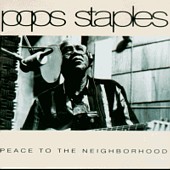 GORDON'S CD
PICK: Peace to the Neighborhood
GORDON'S CD
PICK: Peace to the Neighborhood