|
Singer
Ofra Haza Dies at 41
By RON KAMPEAS Associated Press Writer
JERUSALEM (AP) - Ofra Haza, who melded
ancient Yemenite Jewish devotional poetry with 1980s techno music to become
Israel's first international pop music success, died Wednesday. She was
41.
Haza, who was admitted to Tel Hashomer
hospital in Tel Aviv 13 days ago, died of massive organ failure, Dr. Zeev
Rortenstein said. He refused to say why she was hospitalized or what led
to the organ failure, saying that was her wish.
Haza, the youngest of nine siblings
in a Yemenite Jewish family who lived in the Hatikvah slum of Tel Aviv,
was discovered at age 12 by a talent scout. She attributed her full-throated
voice to singing at home with her mother. By the time she was 19,
she was a bubble gum pop success.
``She was Israel's first female pop
idol,'' said Benny Dudkevitch, Israel radio's pop music editor.
Her signature song was the defiant
1979 hit, ``The Tart's Song,'' a celebration of being everything - funny,
flirtatious, consumerist - a young woman of the time was not supposed to
be, with the chorus declaring, ``I wanna shout out loud, `I'm a tart!'''
Later in her career, Haza was among
the artists who distanced themselves from efforts to consolidate an ``Israeli''
sound and delved into their parents' ethnic roots.
``Yemenite Songs,'' released in 1985
with a photo of her in full Yemenite wedding gear on the cover, was an
instant Israeli hit.
Its signature track, ``Im Ninalu,''
(``If the Gates of Heaven were Locked'') expanded a devotional poem by
17th century rabbi Shalom Shabazi into a modern love song. The melody was
pure Persian Gulf, a climactic assemblage of rising quarter tones; the
beat was pure 1980s drum machine.
But it was not until 1988, when American
rap artists Eric B. and Rakim sampled ``Im Ninalu'' on their dance hit
``Paid in Full,'' that Haza became an international phenomenon.
A savvy self-promoter, she rereleased
``Im Ninalu'' worldwide with English lyrics. It was an outstanding success.
The rerelease of ``Yemenite Songs,''
and her next album, ``Shaday,'' brought her worldwide attention - suddenly
Ofra Haza was the byword for world music. Reviewers would describe other
ethnic music phenomenons as ``the Bulgarian Ofra Haza'' or ``the Indian
Ofra Haza.''
``For audiences in Europe and the
Far East, this was something completely new,'' Dudkevitch said. ``In Germany
alone, it was selling 15,000 copies a day.''
Haza's insistence on privacy only
stoked the Israeli public's interest in her life. She made headlines in
1987 when she survived a small airplane crash. She kept her marriage two
years ago to businessman Doron Ashkenazi out of the public eye.
After a flush of attention that lasted
into the early 1990s, her fame receded, although she continued to make
high-profile appearances. She performed in Oslo when Prime Minister Yitzhak
Rabin, Foreign Minister Shimon Peres and Palestinian leader Yasser Arafat
won the Nobel Peace Prize in 1994, and she sang the role of Moses' mother
in the 1998 film ``The Prince of Egypt.''
In Haza's last days, fans gathered
at the hospital, anxious for word of her recovery. After her death was
announced, Israeli radio stations switched to retrospectives of her music.
Prime Minister Ehud Barak said she
represented the Israeli success story.
``Ofra emerged from the Hatikvah
slums to reach the peak of Israeli culture,'' he said. ``She has left a
mark on us all.''
There was no word on funeral arrangements,
or information about survivors other than her husband.
|
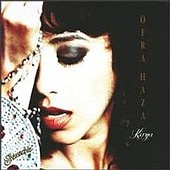
 Ofra
Haza discography
Ofra
Haza discography