|
An
Individual Voice on Cornet
by Kenny Mathieson
Copyright © 2000 Kenny Mathieson
The Scotsman, 2000
http://www.jazzhouse.org
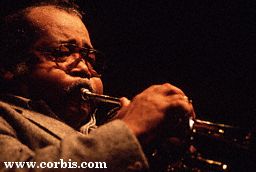
Nat Adderley may have spent a significant part of his career in the shadow
of his better known
older brother, the alto saxophonist Julian 'Cannonball' Adderley, but he
was always a major
contributor to their shared projects, and achieved a great deal in his
own right after his
brother's death in 1975.
He was born Nathaniel Adderley, and took up trumpet as a teenager in 1946.
He began
playing in local bands in Florida, and made what became a career long switch
to the smaller
cornet in 1950. He did so against the prevailing tide. Cornet had been
the horn of choice for
New Orleans trumpet players in the early days of jazz, but had fallen out
of fashion in favour of
trumpet by the bop era.
Adderley evolved a distinctive signature on the instrument, blending a
rich tone and earthy
warmth with the horn's inherent touch of astringency to great effect. He
played in an army band
for a time during his military service from 1951-3, then joined the band
led by vibraphonist
Lionel Hampton in 1954, his first association with an established jazz
figure. He remained with
Hampton until 1955, and cut his earliest recordings for the Savoy and EmArcy
labels that
same year.
Cannonball Adderley had made an early mark in New York when he sat in with
bassist Oscar
Pettiford at the Cafe Bohemia in Greenwich Village in 1955, but that did
not translate into
immediate success when the brothers joined forces in Cannonball's Quintet
the following year.
He broke up the group in 1957, and Nat worked with trombonist J. J. Johnson
and
bandleader Woody Herman before reuniting with his brother in 1959.
The earlier lack of success quickly evaporated. The band's funky, gospel-tinged
jazz became
one of the most successful sounds on the hard bop and soul jazz circuit,
and they even scored
an unexpected chart hit with 'Mercy,
Mercy, Mercy' in 1966. Cannonball had featured
alongside John Coltrane in Miles Davis's classic Sextet which made the
legendary Kind of
Blue album in 1959, and that association provided the boost he needed to
take off as a star in
his own right, with the cornetist very much his right hand man.
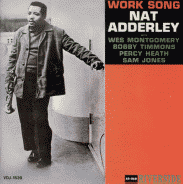
Nat had continued to record under his own leadership, and made his most
famous record for
the Riverside label in January, 1960, with a band which featured guitarist
Wes Montgomery.
The resulting album,
Work Song , included the tune which remains his best known
composition, 'The
Work Song'. Its bluesy call-and-response chorus was an emblematic
example of the hard bop style of the period, and is still widely played.
It became a mainstay of the Adderley's as well as the hard bop repertoire,
but was not the
only composition by the cornetist to do so. His significant contributions
as a composer also
include widely performed tunes like 'Jive
Samba', 'Hummin'',
'Sermonette',
and 'The
Old
Country'.
His role as a soloist was no less significant, and he was equally adept
at uptempo hard bop
excursions and richly delineated ballads. Miles Davis had been an early
influence on his style,
but he developed a highly individual and very expressive voice of his own,
which included a
sparing but effective use of the very low registers of the horn.
Nat remained a central part of his brother's various projects until the
saxophonist's unexpected
and premature death from a stroke in 1975. Their collaboration included
an ambitious but very
uneven "folk musical" based on the tale of the mythical black hero figure,
John Henry, with
lyrics by Diane Lampert and Peter Farrow. It was released on record as
Big Man (Fantasy) in
1975, with the late Joe Williams singing the title role, and soul diva
Randy Crawford making
her recording debut as Big John's woman, Carolina.
A concert performance was given at Carnegie Hall the following year as
a tribute to the
saxophonist, and a full theatrical production under the title Shout Up
A Morning was
eventually staged at the Kennedy Centre for the Performing Arts in Washington
and the La
Jolla Playhouse in California in 1986.
The cornetist had formed his own band shortly before his brother's death,
and he continued to
lead it until 1997, when his right leg was amputated following complications
from diabetes,
which would eventually lead to his death.
Bassist Walter Booker was a virtual ever-present in the band, but Adderley
was equally open
to the younger generation of players, and featured the likes of pianist
Rob Bargad and alto
saxophonist Vincent Herring for extended periods. He was appointed artist
in residence to the
faculty of Florida Southern College in 1996, and was inducted into the
Jazz Hall of Fame in
Kansas City in 1997.
If he made his classic contributions to the music in the early 60s, he
remained a highly
resourceful and always musical performer throughout his long career, and
left a rich recorded
legacy in his many albums with his brother, under his own leadership, and
as a sideman.
His son, Nat Adderley, Jr, is also a musician. He is also survived by his
wife, Ann; his
daughter, Alison; and five grandchildren.
Kenny Mathieson
Kenny Mathieson is a freelance writer based in Scotland. His book Giant
Steps: Bebop and The Creators of Modern Jazz (1999) is published by
Payback Press.
E-mail: [email protected]
|
|
Nat
Adderley, Cornetist, Composer, And Brother Of Cannonball, Dies At 68
Nat Adderley, the cornetist and composer of such jazz standards as
"Work
Song" and "Jive
Samba," died in Lakeland, Fla. on Sunday (Jan. 2)
after an extended battle with diabetes. He was 68.
Nat Adderley became a well-known figure on the post-bop jazz scene
in
the mid-1950s in groups with his older brother, alto saxophonist
Julian
Adderley, who was better known as Cannonball. Although
the two were always associated, and often played together
until the elder Adderley's death in 1975, Nat Adderley forged
his own path as a performer, and especially as a composer.
Many Nat Adderley compositions have become part of the
canon of jazz standards, including "Sermonette,"
"Jive
Samba,"
and especially "Work
Song," which became a vehicle for
vocalists as well after the addition of words by Oscar Brown, Jr.
"He was a beautiful cat, he really was," says saxophonist
Sonny Fortune, who played in Adderley's band in the 1980s,
"Nat played incredible cornet -- whoa! And he wrote some
great music. Nat was a good man."
Nathaniel Adderley was born Nov. 25, 1931 in Tampa, Fla.,
and made his first forays into music as a child singer. When
his voice started to change as an adolescent, Adderley
learned to play the trumpet with the instruction of brother
Julian, who played the instrument before switching to
saxophone. Nat Adderley played trumpet until 1950, when he
picked up the cornet. "When he was playing cornet, cornet
was more or less a thing of the past," said Fortune, "but he
was playing the daylights out of the cornet."
The Adderley brothers joined the military in 1951, and played
together in the 36th Army Band until 1953. After returning to
civilian life, Nat Adderley finished his education, after which
he joined the Lionel Hampton Orchestra. By 1955, Nat
Adderley was playing with Cannonball in the latter's
ensembles, based in New York. Some of the brothers' earliest
sessions together have been recently reissued on the Savoy
Jazz label as The Summer of '55. Nat played with J.J.
Johnson and Woody Herman while Cannonball was playing
with Miles Davis, but rejoined Cannonball's band in 1959.
On his own albums, Nat Adderley performed with a number of
jazz greats that included Bobby Timmons, Wes Montgomery,
Johnny Griffin, Percy Heath, Joe Zawinul and many others.
His 1960 album Work Song introduced his most famous
composition. Following in the tradition of brother Cannonball,
Nat Adderley would entertain audiences with between-song
chats that relied on his extensive knowledge of jazz, and
were usually tempered with infectious humor. According to
Fortune, "Nat used to say, almost every night, especially
introducing 'Work
Song' -- he would make a big joke out of
it: 'Yeah, that's one of my compositions and I play my
compositions. And I feel good about playing my
compositions, because I don't play them, who will?'"
After Cannonball's death, Nat worked to stage the jazz
musical Big Man, The Story of John Henry, which the
brothers had written together. Adderley also started a band
with reedmen Ken McIntyre and John Stubblefield, and
continued to lead his own groups into the 1990s with such
sidemen as Fortune, Jimmy Cobb, Vincent Herring, and
Walter Booker. Adderley's touring became gradually more
restricted with his advancing diabetes, for which he had his
right leg amputated in 1997. That same year, he joined the
faculty of Florida Southern College as artist in residence.
Nat Adderley is survived by his wife, a son, and a daughter.
--
Drew Wheeler |
NY
TIMES
Nat
Adderley, Jazz Cornetist and Composer, Is Dead at 68
By BEN RATLIFF
Nat Adderley, a jazz cornetist and trumpeter who was a frequent
collaborator with his brother, the saxophonist Cannonball
Adderley, and a composer whose style popularized a melodic, bluesy,
secular gospel-jazz, died on Sunday at a hospice in Lakeland, Fla.
He was 68 and lived in Lakeland.
The cause was complications from diabetes, said Fred Stuart, his
publicist.
Mr. Adderley was born in Tampa, Fla., and began his career playing
with bands in Florida. In 1950 he changed from trumpet to cornet, and
during the early 50's he played with a military band in the Army. In 1954
he joined Lionel Hampton's group, and in 1956 he became part of the
Adderley Brothers quintet started by his brother, an alto saxophonist.
That group disbanded in 1957 and the brothers reunited in the
Cannonball Adderley Quintet before the end of the decade. With
Cannonball Adderley's buoyant, linear style and Nat Adderley's more
dynamic sound, the quintet became one of the longest-running groups in
postwar jazz, remaining active until Cannonball Adderley died in 1975
and making a series of hard-hitting records. Three of the most popular
songs in its repertory, which all became standards, were written by Nat
Adderley: "The
Work Song," "Jive
Samba" and "Hummin'."
Mr. Adderley, who had also appeared as a sideman on other records by
musicians including Kenny Clarke, Wynton Kelly and Jimmy Heath,
started his own band shortly after his brother's death, modeled on the
music they played together. The alto saxophonist Vincent Herring often
played the Cannonball Adderley role in the band. The group recorded
for Enja, Landmark and other labels, and performed widely for about 20
years, until Mr. Adderley lost a leg because of diabetes in 1997.
Nat Adderley's band was one of the more stable groups in jazz: the
bassist Walter Booker remained with him for most of two decades and
the pianist Rob Bargad played with him through the 1990's.
Outside his group, Mr. Adderley also collaborated with his brother on a
musical about the folk hero John Henry. It was released as an album,
performed as a concert at Carnegie Hall in 1976, and then as a full
theatrical production called "Shout Up a Morning" at the Kennedy
Center for the Performing Arts in Washington and the La Jolla Playhouse
in California in 1986.
Mr. Adderley is survived by his wife, Ann; a son, Nat Adderley Jr. of
West Orange, N.J.; a daughter, Alison Pittman of Palm Bay, Fla.; and
five grandchildren.
|
|
 NAT
NAT
 Cannonball