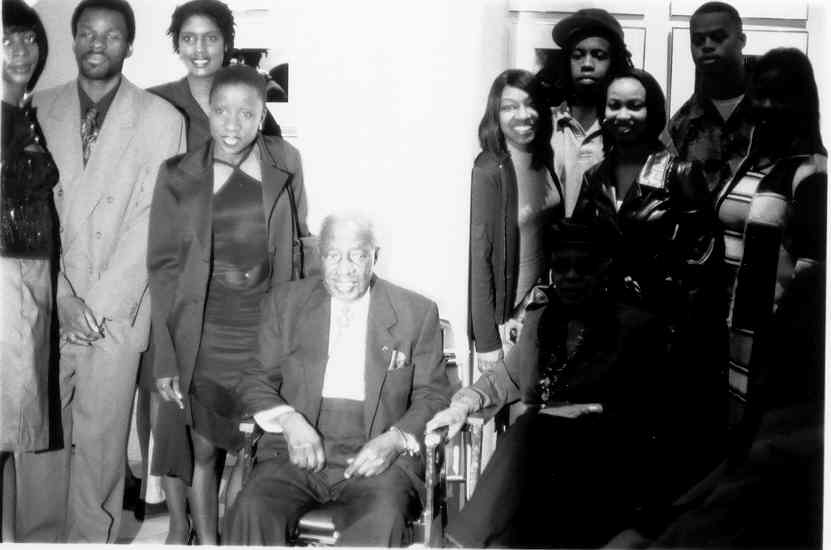
Milt Hinton, one of the
most recorded musicians of all time and the dean of American bass players, died on Tuesday
at Mary Immaculate Hospital in Queens. He was 90 and lived in St. Alban's, Queens.
One of the first great bass soloists in jazz, he began his career when the
string bass was just replacing the tuba in jazz bands and remained as one of the most
sought-after jazz musicians more than seven decades later.
Mr. Hinton's high standards, superb intonation and impeccable timing made
him a favorite accompanist for some of the biggest names in jazz and for a wide range of
performers outside jazz. His comment that he had made "more records than
anybody" was not a boast but a simple observation, and no one has disputed it.
Estimates how many records on which Mr. Hinton played range from 600 to
well over 1,000. The list of artists he worked with begins with Cab Calloway, with whom he
spent 15 years, and includes instrumentalists like Louis Armstrong, Count Basie, Duke
Ellington and Benny Goodman; and singers like Frank Sinatra, Barbra Streisand, Billie
Holiday and Bing Crosby.
Mr. Hinton's big round bass tones can also be heard on early rock 'n' roll
hits by the Drifters and the Coasters and easy-listening albums by André Kostelanetz and
Guy Lombardo. Musicians valued Mr. Hinton not just for musicianship and versatility but
also for his easygoing nature and his professionalism. He earned his nickname, the Judge,
because he would invariably be the first to arrive at a recording session and the other
musicians took to greeting him when they showed up with the punch line of an old joke,
"Well, good morning, Judge!"
A Technique for Slap Bass
Mr. Hinton was among the last acknowledged masters of the exaggerated
pizzicato technique known as slap bass, in which the strings are pulled back at high
tension and released suddenly. But his slap technique was more fluid than that of
predecessors like Pops Foster, and he had a greater technical arsenal. Mr. Hinton's bowing
technique was considered superior to that of any jazz bassist before him and those of most
who came after him.
"The bass is a service instrument," he once said. "The word
`base' means support, foundation. If you put up a building, the foundation must be steady
and strong. I must identify the chord for everyone, and only after that can I play the
other notes. You learn to have a lot of humility. You must be content in the background,
knowing you're holding the whole thing together."
He was devoted to helping younger musicians carry on the jazz tradition.
He taught jazz courses at Hunter College and Baruch College in the 1970's and 80's. In
1980 he established the Milton J. Hinton Scholarship Fund for young bassists.
For six decades he also actively pursued a hobby that virtually qualified
as a second career: photography. Shortly after he received a $25 Argus camera as a
birthday present in 1935, he began taking candid shots of the musicians he worked with.
"I wanted to show them the way they are," he said. "Everyone sees musicians
up on a stage, but I wanted to show them asleep in a bus or in a railroad station or
listening intently to a playback."
He graduated from the Argus to a Leica and became almost obsessive about
documenting the jazz life. His photographs also documented changes in American society,
from the days when black musicians traveling in the South ate at "colored only"
restaurants to the days when racially integrated bands were more the rule than the
exception.
Mr. Hinton put on several photo exhibitions and published
two books of photographs and reminiscences, "Bass Line" (1988) and "Over
Time" (1991). Both books were written with David G. Berger, a Temple University
professor who spent years helping him catalog his photographs.
Milton John Hinton was born in Vicksburg, Miss., on June 23, 1910. His
parents separated when he was an infant; his mother soon moved to Chicago and sent for her
mother and her son when he was 9. Four years later, with his mother's encouragement, he
began studying the violin.
At Wendell Phillips High School in Chicago, he played violin in the
orchestra and tuba in the marching band. He later attended Crane Junior College and
Northwestern University briefly before leaving to pursue a career in music.
Mr. Hinton taught himself to play the string bass in 1929 because
opportunities for violinists were limited: big movie-theater orchestras were being phased
out with silent films, and symphony orchestras were not yet hospitable to black musicians.
The bass was in its infancy as a jazz instrument, with the tuba still providing the base
line for the ensemble melody and solo improvisations in many bands. Mr. Hinton's technique
stood him in good stead.
"Studying the violin gave me the ability to play melody on the bass,
and it also gave me a great deal of dexterity," he said. "All the guys I heard
used their arms to slap, but I developed a way to slap with my wrists."
He was soon working around Chicago with the bands of Eddie South, Erskine
Tate and other stars. He was at a Chicago nightclub, the Three Deuces, with a group led by
the drummer Zutty Singleton in 1936 when Cab Calloway offered him a job. Calloway, already
one of the biggest stars in jazz, was on his way back to New York from Hollywood. His
bassist, Al Morgan, had abruptly left and Calloway hired Mr. Hinton just a few hours
before the band's train was to leave Chicago. Mr. Hinton recalled years later that
Calloway had told him he planned to "find him a good bass player" once the band
got to New York. Instead, Mr. Hinton remained with Calloway for 15 years.
"Calloway was my musical father," Mr. Hinton said. "He was
so kind to me, and he gave me the opportunity to grow." Mr. Hinton was one of the
first jazz bassists to be featured on records as a soloist. The Calloway band's recordings
of "Pluckin' the Bass" in 1939 and "Ebony Silhouette" in 1941 were
showcases for Mr. Hinton. Along with similar recordings made by Duke Ellington's
orchestra, then featuring Jimmy Blanton, they were, as the jazz historian Gunther Schuller
said, "pioneer efforts, unrivaled at the time."
As big bands began to fall out of fashion in the late 1940's, Calloway
eventually scaled his big band down to a small combo, retaining Mr. Hinton as his bassist,
and broke that band up for good in 1951. For the first time in 15 years, Mr. Hinton, who
by now had a wife and daughter to support, was out of work.
Helping Hand From Jackie Gleason
That did not last long. After a brief period of scuffling, he began to get
freelance work at New York nightclubs. He spent two months with Count Basie in early 1953
and that summer joined Armstrong's sextet for a seven-month engagement.
He also became one of the first black musicians to gain entry into the New
York recording studios, largely thanks to Jackie Gleason, whom Mr. Hinton had known since
his days as a nightclub comedian and who was then fronting an orchestra that put out
mood-music albums .
"One day on a street corner, I ran into Jackie Gleason," Mr.
Hinton said. "He asked me what I was doing, and I said, 'Not working.' He
immediately told his manager to hire me for a record date the next day. The manager had
already hired a bassist, and now he had two! That's how faithful a friend Jackie
was."
"When I got there all the white musicians recognized me, and it was
never a problem with them," he added. "It was the powers that be who were scared
to send a black person on TV into a living room down South. After that, Clark Terry,
Snooky Young, Jerome Richardson, Hank Jones and a lot of other musicians started to work
and we were appreciated."
As word of Mr. Hinton's talent spread, numerous singers, instrumentalists
and band leaders quickly followed Gleason's lead. Mr. Hinton's studio work soon extended
into radio and television, beginning with a call to join the band on Robert Q. Lewis's
daily television program in 1954.
His presence occasionally seemed a bit anomalous in the white world of
early television, as when he was part of a group of musicians and singers dressed in
Confederate Army uniforms for a performance of "The Yellow Rose of Texas" by an
ensemble led by Mitch Miller on Gleason's show. Things had changed by the early 70's, when
Mr. Hinton — in a suit and tie this time — was a prominently featured member of
Bobby Rosengarden's orchestra on Dick Cavett's late-night talk show.
By that time, the situation in New York's recording studios had changed as
well. The rise of self- contained rock groups and electronic instruments, among other
factors, had led to a sharp drop work for studio musicians. But Mr. Hinton adapted. He
agreed to tours with Paul Anka, Pearl Bailey and other vocalists. He began teaching. He
joined the jazz panel of the National Endowment for the Arts. He became the unofficial
bassist in residence at the New York cabaret Michael's Pub, which honored him on the
occasion of his his 75th birthday in 1985 with a five-week engagement as a headliner.
He is survived by his wife, Mona; a daughter, Charlotte Morgan; and a
granddaughter.
He also began recording prolifically as a leader for the first time. Among
recent albums under his own name the most noteworthy was "Old
Man Time," a two-CD set on the Chiaroscuro label with guest stars like Dizzy
Gillespie and Lionel Hampton, and spoken reminiscences by Mr. Hinton. His last album,
"Laughing at Life," was released by Columbia Records in 1995.
"I was pretty young when I realized that music involves more than
playing an instrument," Mr. Hinton wrote in the closing passage of "Bass
Line." "It's really about cohesiveness and sharing. All my life, I've felt
obliged to try and teach anyone who would listen. I've always believed you don't truly
know something yourself until you can take it from your mind and put it in someone
else's."