 Jan
17, 1998Jan
17, 1998
Jan
17, 1998Jan
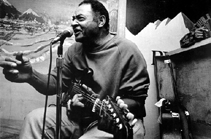
17, 1998Members of U2 and the Rolling Stones attended his legendary house parties.
Addicted To Noise Staff Writer Chris Nelson reports:
Although Mr. Kimbrough had first recorded his mix of
country blues and soul music as early as 1966, he only
came to wider public attention in the 1990s, when the
Fat Possum label began releasing his work, along with
that of contemporaries such as R.L. Burnside.
A hospital stay after a recent car accident had woken
Mr. Kimbrough up to lingering health problems
including diabetes and gall stones, said Amos Harvey,
a spokesman for Fat Possum. "When I saw him a
couple times before Christmas, he said he was getting
stronger and wanted to play again," Harvey said. "He
had a renewed vigor to go ahead and start playing
again."
Mr. Kimbrough's guitar playing was marked by the
repetitive rhythms often associated with musicians
from northern Mississippi. His vocal style was often
compared to that of regional forebears such as Bukka
White and Fred McDowell.
In addition to garnering acclaim with the Fat Possum
albums All Night Long, Sad Days, Lonely Nights and
Most Things Haven't Worked Out, Mr. Kimbrough
was known for hosting rollicking house parties in his
Holly Springs living room.
"Usually it would be 15 or 20 people, coming and
going, drinking, talking, dancing, passing out, the
occasional fight," Dr. David Evans told Addicted To
Noise last year. Evans, a Memphis State University
ethnomusicologist who recorded Mr. Kimbrough and
attended the regular parties thrown by him and
Burnside, worked with Mr. Kimbrough in 1982 and '88
on recordings that were released last year under the
title Do The Rump! (Hightone).
In 1991, Mr. Kimbrough was captured on film in the
documentary Deep Blues, which was produced by the
late music critic Robert Palmer. On several occasions,
Palmer brought famed rock stars, from the Rolling
Stones to U2, over to Mr. Kimbrough's parties, where
they would sit in with the band to varying degrees of
success.
"He'll still live on with us," Harvey said. "You won't get
to see him much, but his music's there."
Mr. Kimbrough is survived by his common law wife
Mildred. He claimed to have 36 children, Harvey said.
[Tues., Jan. 20, 1998, 9 a.m. PST]
Junior Kimbrough was born and raised in Hudsonville, Mississippi, where
he
learned how to play guitar by listening to records by Delta bluesmen. In
1968, he
cut his first single, "Tramp," for the local Philwood label. For the next
two
decades, Kimbrough didn't have the opportunity to record frequently --
he recorded
a single, "Keep Your Hands Off Her," for High Water and his "All Night
Long" was
available on the various artists compilation National Downhome Festival,
Vol. 2
released on Southland Records.
During the '70s and '80s, Kimbrough played juke joints throughout Mississippi,
which is where music journalist Robert Palmer discovered him in the late
'80s.
Palmer featured Kimbrough in his documentary film Deep Blues. The exposure
in
the movie led to a national record contract for Kimbrough -- he signed
with Fat
Possum and released his first full-length album, All Night Long, in 1992.
The
record was critically acclaimed by both blues and mainstream publications,
as
was Deep Blues and its accompanying soundtrack. All of the media attention
led
to performances outside of the Delta, including a few shows in England.
After the
flurry of activity in 1992, Junior Kimbrough returned to playing juke joints
in the
Delta, recording occasionally -- he released his second album, Sad Days,
Lonely
Nights, in 1993. Most Things Haven't Worked Out followed in 1997

|
|
|
|
|
|
SHAMEFUL DISCLAIMER |