NY
TIMES
|
Julie
London, Sultry Singer and Actress of 50's, Dies at 74
By DOUGLAS MARTIN
Julie London, whose understated voice and striking honey-blond
appearance made her one of the top female vocalists of the 1950's and 60's, died
yesterday at a hospital in Southern California. She was 74.
Miss London, who lived in the San Fernando Valley, suffered a stroke five years
ago and was in poor health, a spokesman
for Encino-Tarzana Regional Medical Center told
The Associated Press.
She was also an actress in scores of movies and television shows,
including the popular role of Nurse Dixie McCall in "Emergency!"
in the 1970's.
Miss London went from playing bit parts in the early 1940's
to starring roles and pin-up status among World War
II servicemen. Then, in 1947, she married the actor
Jack Webb, later famous on "Dragnet," and stopped
working to be a full-time wife and mother. After they
divorced five years later, she became a serious singer under the tutelage of Bobby
Troup, a jazz musician and
songwriter.
Her first 45 single, released in 1955, was "Cry Me a River," and
it was included on her first album, "Julie Is Her Name."
More than three million copies of the album and single were
sold. She made more than 30 albums.
She was voted one of the top female vocalists of 1955, 1956
and 1957. On New Year's Eve 1959, she married Mr. Troupe,
who died last year.
Adjectives such as sexy, intimate, breathy, husky and suggestive
were applied to her singing. The singer herself told
Life magazine in 1957: "It's only a thimbleful of a
voice, and I have to use it close to the microphone. But it is a kind of oversmoked voice and it automatically sounds intimate."
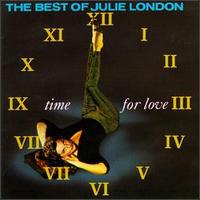
Her sound and her looks were closely intertwined. Most of her
albums were graced by sultry, yet sophisticated
pictures of her.
Miss London was born as Julie Peck in Santa Rosa, Calif., on
Sept. 26, 1926. Her parents, Jack and Josephine Peck formed
a song and dance team in vaudeville and radio. In 1929,
they moved to San Bernardino, where her parents had
a radio show on which Julie sometimes appeared. In 1941,
they moved to Los Angeles and she graduated from Hollywood
Professional High School.
She then took a job as an elevator operator in a department
store where she was discovered by talent agent
Sue Carol, the wife of the actor Alan Ladd. She appeared in her first film, "Nabonga," in 1944, and began singing with the Matty Malnech Orchestra. She met Mr. Webb
who was then in the Marine Corps. They married in 1947,
and she gave up her budding movie career to become
a full-time wife and mother.
They had two daughters, Stacy and Lisa. They divorced in 1953.
After meeting Mr. Troupe she began singing again, recovering
some of what she called sagging confidence.
Her movie career also revived. She starred as an alcoholic singer
in the 1956 film "The Great Man." She then starred or
co-starred in "Man of the West," "Voice in the Mirror,"
"The George Raft Story" and "The Third Voice." She composed
the title song for "Voice in the Mirror."
In 1972, she began her role in "Emergency!" After the show
ended in 1977, she did one last film before retiring from
show business.
She is survived by a daughter from her marriage to Mr. Webb,
Lisa Breen of Manhattan Beach, Calif. She also left three
children from her 39-year marriage to Mr. Troupe: a daughter, Kelly Ronick of West Los Angeles, and twin sons, Jody,
of Los Angeles, and Reese, of West Los Angeles. |
"Emergency!"
Star Julie London Dies
Julie
London, forever nurse Dixie McCall in TV Land's Emergency! reruns, died
Wednesday at the age of 74.
London,
in poor health since suffering a stroke five years ago, died
of cardiac arrest at 5:30 a.m. in Encino-Tarzana Regional Medical Center in
suburban Los Angeles, a hospital
spokesperson confirmed.
On
Emergency!, London played the head nurse of Los Angeles' fictional Rampart
Hospital, who
aided the victims brought in by ace paramedics Roy DeSoto (Kevin Tighe)
and John Gage
(Randolph Mantooth). The series, which ran on NBC from 1972 to 1977, was
something of a family affair for London. It was produced by her ex-husband,
Dragnet star Jack
Webb, and it costarred her second hubbie, jazzman-composer-actor Bobby
Troup, who
played Dr. Joe Early, resident brain surgeon. (Troup
died last year of heart failure at
80.)
While
she will be remembered for her tube work on the vintage '70s series, London
was also a smoky-voiced singing
sensation.
She
initially made her show-biz mark as a singer on the nightclub circuit.
After scoring a hit with " Cry Me a
River" in 1955, Troup (who wrote the classic "Route 66") got her
booked for several nightclub engagements. She eventually recorded 32 albums and
charted with such tunes as "In the Middle of a Kiss" and "My Heart Belongs to
Daddy," "You'd
Be So Nice to Come Home To," "Around Midnight" and "In the Wee Small Hours
of the Morning." Billboard voted her
one of the top female vocalists of 1955, '56 and '57.
London,
who had in her youth appeared in such films as Jungle Woman (1944), The
Red House (1947) with Edward G.
Robinson, Task Force (1949) with Gary Cooper, The Fat Man
(1950) with Rock Hudson, returned to acting in the late '50s and '60s. She
appeared in the film A Question of
Adultery in 1958 and on such TV shows as Rawhide, I Spy and Big
Valley before landing the Emergency! gig.
The
daughter of vaudevillians, she was born Julie Peck in Santa Rosa, California,
and moved with her parents to Los
Angeles when she was in her teens, and soon caught the eye
of talent scouts, which led to her first screen roles.
London
is survived by a daughter from her marriage to Webb and three children
from her 39-year marriage to Troup.
Funeral
arrangements are pending. Per Hollywood tradition, flowers were placed
on her Walk
of Fame star Wednesday evening. ~ E
Online |
Julie
London; Torch Singer, Movie and Television Actress
By MYRNA OLIVER, LA Times
Staff Writer
Julie London, the smoky-voiced torch
singer who insisted she couldn't sing but
whose voice sent shivers down spines and whose
album covers alone turned men weak in the knees and women green
with envy, died Wednesday. She was 74.
London, the sultry actress who declared
herself no Sarah Bernhardt but is remembered
as head nurse of the 1970s television series
"Emergency," died in Encino Hospital. Meyer Sack, her
longtime business manager, said she died of complications of a stroke
suffered five years ago.
Her first recorded single, "Cry Me a
River" in 1956, propelled her into musical
history. Relatively unknown as an actress despite a spate of films in the
1940s, London also caught fire on screen the same year as alcoholic singer Carol Larson in Jose Ferrer's "The Great
Man."
Theme magazine dubbed her its "most
exciting new vocalist" for the year
and Variety applauded the actress "who digs into a dramatic
role and socks it across with aplomb."
London recorded more than 30
albums--among them "Julie Is Her Name,"
"Lonely Girl," "Calendar Girl," "About the Blues," "Make
Love to Me," "London by Night"--with that voice connoisseurs described as smoky,
husky, breathy, haunting, intimate and even "a voice for a smoke-filled room."
Maybe they called it smoky because she
smoked too much, she joked, and maybe breathy because she never learned how to
breathe properly, and intimate because "I'm a girl who needs amplification."
Despite her vaunted voice and beauty, she was known for zero
self-confidence and always credited her success to good material in song or
script.
When she played a pseudo Marilyn Monroe
in the 1963 television drama "Diamond in the Sky," London scoffed at
comparisons, insisting: "We're
opposite types. Marilyn was the sex symbol. . . . I'm
strictly the housewife-mother type."
Yet London's mere appearance, with her
statuesque figure, had such an effect on men
that critics were never certain whether her
albums sold so well because of her vocal prowess or her sexy photos
on the cover.
"Just as long as they buy the records, I
don't care why they buy 'em," she happily told The Times in 1961, later joking: "We spent
more time on the covers than the music."
In the early 1960s, when cigarettes were
advertised on television, London memorably
crooned "The Marlboro Song" to a swain in a convertible or beach house. A
hard-bitten Times business writer confessed that London was the only woman on
television who could persuade him to buy anything--adding that he smoked a dozen
of her touted brand while interviewing her.
When London testified before the U.S.
Senate in 1967 that performers deserved copyright protection as much as writers,
a nationally syndicated political writer threw objectivity to the winds and
slavered: "Miss London stole the show. . . . She had come in a
high dress, a blue woolly-shifty thing that touched all the bases like a
grand-slam home run. Her eyelashes were three furlongs of black beachcombers and
her hair was spun brass. . . ."
Entertainment writers never even
pretended reserve. In the 1940s, a Times critic called the teenager "a young
Bette Davis . . . provocative, decisively
different." A decade later, another described her as "a magnificently
assembled blond child. . . ."
London was born to her roles as actress
and singer, yet achieved each in the kind of fluke Hollywood loves to make
movies about. She was born Julie Peck
in Santa Rosa, Calif., the daughter of a
radio and vaudeville song-and-dance team, and made her own vocal
debut on radio at age 3. She grew up in San Bernardino, where her parents sang
on local radio, and in Los Angeles, where she dropped out of school at 15 to
hire on as a $19-a-week department store elevator operator.
At 17, she tried singing with a band for
a few months, but soon went back to the
elevator. One of her passengers, talent agent Sue Carol, the wife of Alan Ladd,
decided anybody that beautiful needed a
screen test.
At 18, London made her official film debut opposite Buster Crabbe in the 1944 "Nabonga," later retitled "Gorilla," a film she
preferred to forget. Most notable of her early films was the 1947 "Red House,"
starring Edward G. Robinson.
As her acting career began to blossom,
she met and married the obscure star of a radio drama called "Pat Novak for
Hire," Jack Webb. They married in 1947, and when his television show "Dragnet"
put them in the money a few years later, she became a happy housewife until
their divorce in 1953.
Bobby Troup, her second husband, proved the Svengali for
London's singing career, cajoling and encouraging her to go public after he
heard her sing beside his piano at a private party. He booked her into Los
Angeles' 881 Club for three weeks. She stayed 10 and
went on to become a recording and saloon singing star, appearing frequently on
TV variety shows hosted by Dinah Shore, Bob Hope,
Steve Allen and Perry Como.
Troup, the songwriter of such hits as
"Route 66," even got her to write a
song or two, namely the title song--which she also sang--for
her 1958 film about Alcoholics Anonymous, "The Voice in the
Mirror."
London married Troup on New Year's Eve,
1959. Webb rescued them from the road and the nightclub circuit a decade or so
later by hiring them both for his Mark VII Productions' "Emergency." London was
nurse Dixie McCall to Troup's neurosurgeon Dr. Joe Early
during the series' run from 1972 to 1977.
The actress London's last motion picture
was "The George Raft Story" in 1961, in
which she portrayed Raft's first girlfriend, Sheila Patton. The singer London's last album was "Easy Does It" in 1969,
which she considered her best.
After "Emergency" went off the air,
London happily retired. But her indelibly stylistic singing still finds its way
onto movie soundtracks in such films as "Teaching Mrs. Tingle" last year and
"The Big Tease" earlier this year.
A widow since Troup's death in early 1999, London is survived by
four children: Lisa Webb Breen of Manhattan Beach; Kelly Troup Romick of West Los Angeles; and twin sons Reese Troup of West
Los Angeles and Jody Troup of Sherman Oaks. Another daughter,
Stacy Webb, died several years ago in a car accident.
Services will be private. The family has
asked that any memorial donations be made to the UCLA Johnson Cancer Clinic.
|
|