|
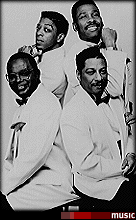
The Drifters
Formed in 1953 in New York, USA, at the behest
of Atlantic Records, this influential R&B vocal group was initially
envisaged as a vehicle for ex-Dominoes’ singer, Clyde McPhatter. Gerhart
Thrasher, Andrew Thrasher and Bill Pinkney completed the new quartet which,
as Clyde McPhatter and the Drifters, scored a number 1 R&B hit with
their debut single, Money Honey.
Follow-up releases, including Such A Night,
Lucille and Honey Love (a second chart-topper), also proved highly successful,
while the juxtaposition of McPhatter's soaring tenor against the frenzied
support of the other members provided a link between gospel and rock ‘n’
roll styles. The leader's interplay with bassist Pinkney breathed new life
into White Christmas, the group's sixth R&B hit, but McPhatter's induction
into the armed forces in 1954 was a blow the Drifters struggled to withstand.
The vocalist opted for a solo career upon
leaving the services, and although his former group did enjoy success with
Adorable (number 1 R&B 1955), Steamboat (1955), Ruby Baby (1956) and
Fools Fall In Love (1957), such recordings featured a variety of lead singers,
including David Baughn and Johnny Moore. A greater emphasis on pop
material ensued, but tension between the group and manager, George Treadwell,
resulted in an irrevocable split. Having fired the extant line-up in 1958,
Treadwell, who owned the copyright to the Drifters’ name, invited another
act, The Five Crowns, to adopt the appellation. Ben E. King (tenor), Charlie
Thomas (tenor), Doc Green Jr. (baritone) and Elsbury Hobbs (bass), plus
guitarist Reggie Kimber, duly became ‘the Drifters’, and declared their
newfound role with There Goes My Baby.
Written and produced by Leiber And Stoller,
this pioneering release contained a Latin rhythm and string section, the
first time such embellishments had appeared on an R&B recording. The
single not only topped the R&B chart, it also reached number 2 on the
US pop listings, and anticipated the ‘symphonic’ style later developed
by Phil Spector. Further excellent
releases followed, notably Dance With Me (1959), This Magic Moment (1960) and
Save The Last Dance For Me, the last-named of which topped the US pop chart and
reached number 2 in the UK. However, King left for a solo career following I
Count The Tears (1960), and was replaced by Rudy Lewis, who fronted the group
until his premature death in 1964. The Drifters continued to enjoy hits during
this period and songs such as Sweets For My Sweet, When My Little Girl
Is Smiling, Up On The Roof and On Broadway were not only entertaining in
their own right, but also provided inspiration, and material, for many
emergent British acts, notably the Searchers, who took the first-named
song to the top of the UK chart. Johnny Moore, who had returned
to the line-up in 1963, took over the lead vocal slot from Lewis. Under
The Boardwalk, recorded the day after the latter's passing, was the Drifters’
last US Top 10 pop hit, although the group remained a popular attraction.
Bert Berns had taken over production from Leiber and Stoller, and in doing
so brought a soul-based urgency to their work, as evinced by One Way Love
and Saturday Night At The Movies (1964).
When he left Atlantic to found the Bang
label, the Drifters found themselves increasingly overshadowed by newer,
more contemporary artists and, bedeviled by lesser material and frequent
changes in personnel, the group began to slip from prominence. However
their career was revitalized in 1972 when two re-released singles, At The
Club and Come On Over To My Place, reached the UK Top 10.
A new recording deal with Bell was then
secured and British songwriters/producers Tony Macauley, Roger Cook and
Roger Greenaway fashioned a series of singles redolent of the Drifters’
‘classic’ era. Purists poured scorn on their efforts, but, between 1973
and 1975, the group, still led by Moore, enjoyed six UK Top 10 hits,
including Come On Over To My Place, Kissin In The Back Row Of The Movies’,
Down On The Beach Tonight and There Goes My First Love.
This success ultimately waned as the decade
progressed, and in 1982 Moore left the line-up. He was replaced,
paradoxically, by Ben E. King who in turn brought the Drifters back to
Atlantic. However, despite completing some new recordings, the group found
it impossible to escape its heritage, as evinced by the numerous ‘hits’
repackages and corresponding live appearances on the cabaret and nostalgia
circuits. |