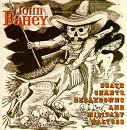
John Fahey, a guitarist who carved out a private corner
of Americana only to see it become a foundation of new age music, died on Thursday at
Salem Hospital in Salem, Ore., after undergoing sextuple heart bypass surgery, said Mitch
Greenhill, the president of Folklore Productions and Mr. Fahey's executor. Mr. Fahey was
61 and lived in Salem.
Playing a six-string acoustic guitar, Mr. Fahey used
country-blues fingerpicking and hymnlike melodies in stately pieces with classical
structures. Wordless and unhurried, his music became a contemplation and an elegy, a stoic
invocation of American roots, nameless musicians and ancestral memories. Behind its serene
surface, the music was both stubborn and haunted.
"I was creating for myself an imaginary, beautiful
world and pretending that I lived there, but I didn't feel beautiful," Mr. Fahey said
in an interview with The Wire magazine in 1998. "I was mad but I wasn't aware of it.
I was also very sad, afraid and lonely."
From the beginning, he was an iconoclast and a
maverick. He started two independent labels. In 1959 he founded Takoma Records, which
released his own albums, blues albums and recordings by other guitarists including Leo
Kottke. And in 1995, he and his manager started Revenant Records, dedicated to what it
called American Primitive music.
Although he didn't sing or write lyrics, Mr. Fahey was
a voluble author of liner notes. His albums were crammed with parodies of academic
analysis and tales of a fictitious blues guitarist, Blind Joe Death, and his disciple,
John Fahey, who purportedly "made his first guitar from a baby's coffin." He
shared a Grammy Award for the liner notes to the 1997 "Anthology of American Folk
Music" (Smithsonian Folkways).
Mr. Fahey was born in Takoma Park, Md., on Feb. 28,
1939. His father and mother both played piano, and his father also played Irish harp. On
Sundays, the family went out to hear bluegrass and country music. Mr. Fahey said that
hearing Bill Monroe's version of Jimmie Rodgers's "Blue Yodel No. 7" and Blind
Willie Johnson's "Praise God I'm Satisfied" changed his life.
He started teaching himself guitar when he was 12. He
also began collecting and trading old 78-r.p.m. recordings of hillbilly songs, blues,
gospel and jazz, going door to door in the rural South to find them. A fellow collector,
Joe Bussard Jr., recorded Mr. Fahey on 78-r.p.m. discs for his Fonotone label, under the
name Blind Thomas. In 1959 Mr. Fahey recorded his first album and pressed 100 copies, the
first Takoma Records album. One side of the LP was credited to "Blind Joe
Death," the other to "John Fahey."
Mr. Fahey studied philosophy at American University in
Washington and then at the University of California in Berkeley, where he played at folk
clubs in his first paid engagements. In 1963, he recorded his second album, "Death
Chants, Breakdowns and Military Waltzes." He and his partner in Takoma Records, ED
Denson, tracked down two Mississippi bluesmen, Bukka White and Skip James, and recorded
them for Takoma, bringing them to new audiences on the folk-revival circuit.
Mr. Fahey entered a graduate program in folklore at the
University of California at Los Angeles in 1964, and wrote his master's thesis about the
Delta bluesman Charley Patton. After he received his degree, Mr. Fahey turned to music
full time.
His compositions expanded, embracing the modalities of
raga along with dissonances not found in country or blues; he used unconventional tunings
and turned some traditional picking patterns backward. He also experimented with tape
collages, often to the annoyance of folk fans. Though hippie listeners may have heard his
music as psychedelic, he was a bourbon drinker.
Along with his Takoma releases, Mr. Fahey also made
albums for Vanguard and Reprise Records. His pristine 1968 solo album of Christmas songs
for Takoma, "The New Possibility," sold 100,000 copies initially and has been
perennially reissued. Mr. Fahey spent time at a Hindu monastery in India; a 1973 album of
extended solo pieces, "Fare Forward Voyager" (Takoma) is dedicated to a guru.
Takoma was sold to Chrysalis Records in the mid- 1970's, and in the 1980's Mr. Fahey made
albums for the Shanachie and Varrick labels. New age performers like the pianist and
guitarist George Winston, who made his first album for Takoma, prospered with a more
ingratiating solo-guitar style.
Mr. Fahey suffered setbacks in the late 1980's. He
divorced his third wife, Melody, and lost his house. He suffered from chronic fatigue
syndrome and diabetes. His drinking grew worse. For a time, he lived at the Union Charity
Mission in Salem. He often supported himself by scouring flea markets for used classical
records to sell to collectors. He sometimes pawned his guitars.
But he was rediscovered in the 1990's. Rhino Records
compiled a retrospective, "Return of the Repressed," in 1994, and alternative
rockers working on "post-rock" instrumental music sought out Mr. Fahey. He
sobered up and restarted his career. In 1996 he released "City of Refuge"
(Tim/Kerr), followed by two albums in 1997 and one each in 1998 and 2000. He continued to
experiment, playing electric and lap steel guitars and freely using electronic effects.
Last year, he published a book of loosely
autobiographical stories, "How Bluegrass Music
Destroyed My Life" (Drag City Press).
"I never considered for a minute that I had
talent," he wrote in 1994. "What I did have was divine inspiration and an open
subconscious."