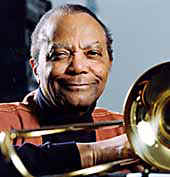
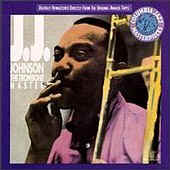
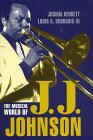
Renowned jazz trombonist dies at 77
By Kevin O'Neal,
Indianapolis Star
James Louis "J.J." Johnson, an
Indianapolis native who gained worldwide fame as one of the greatest trombonists and
arrangers in jazz history, died Sunday. He was 77.
Considered as much a revelation on slide trombone as Charlie Parker was on the
saxophone, Johnson also was a top arranger and composer and was a perennial winner of Down
Beat magazine reader's poll as best trombonist.
As much as he was revered by jazz aficionados, he also made his mark in popular
culture, handling the music for such television shows as Starsky and Hutch and Mayberry,
R.F.D., and films including the original Shaft. He also performed with such
jazz greats as Count Basie and Dizzy Gillespie.
"He was mesmerizing,'' said Alonzo "Pookie'' Johnson, an Indianapolis
saxophonist not related to J.J. who played with Johnson and traveled to Chicago to hear
him play in the days when bebop was a sensation. "He was the most influential
trombone player.''
After spending two decades touring with bands, then years in California arranging and
recording film scores, Johnson returned to his Indianapolis home a dozen years ago and
considered himself retired, although he had performed at the Indy Jazz Fest.
According to a report from the Marion County Sheriff's Department, Johnson, who had
been ill in recent months, committed suicide at his Northside home on Sunday morning.
"It was very devastating,'' said his wife, Carolyn Johnson. "I will truly
miss him.''
Along with Wes Montgomery and Freddie Hubbard, Johnson was one of Indianapolis'
greatest gifts to the jazz world. "He was one of the best of the jazz players,'' said
Virtue Hampton Whited, one of the members of the Hampton jazz family.
Bandleader Jimmy Coe, who attended Attucks High School with Johnson, said he
revolutionized the trombone, turning it into a leading force.
"In those days the trombone was a slow instrument, but that didn't matter to
J.J.,'' Coe said. "He opened a new field for trombonists. He was unlimited.''
Word of Johnson's death began to spread via the Internet Sunday, as jazz fans and
professional musicians e-mailed each other -- hoping it wasn't true. Bill Dinwiddie, a
professional trombone player in Chicago, called The Indianapolis Star newsroom
after he received word, hoping the newspaper would confirm his suspicion that the news was
an urban myth disseminated on the Web.
"He was the giant of the jazz trombone,'' Dinwiddie said, his voice choked with
emotion even though he met Johnson only once -- to shake his hand in a nightclub.
"The man invented an entirely new style . . . I more or less got my start by
listening to his records."
Johnson was born on Jan. 22, 1924. He started on the piano when he was 11, then turned
to the trombone three years later when friends needed a horn for their band.
"I enjoyed it, so I committed myself to that full-bore," Johnson said in 1995
when he was interviewed by The Star about his start with the trombone. "It
didn't begin with that kind of passion. My parents were neutral about it all, but I had
very good music teachers."
Johnson said his Indianapolis musical influences were Norman Merrifield, a music
teacher at Attucks, along with piano player Erroll Grandy.
As his talent grew, Johnson left the Indianapolis scene and headed to the jazz mecca of
New York. While touring with jazz bands during the heyday of those ensembles, Johnson
played with the Clarence Love and Snookum Russell bands before he got his first big break
with the Benny Carter band in 1942.
"J.J. and Carter used to get put out of hotels for practicing too loud,'' Coe
recalled.
In those days, Johnson developed the rapid-fire playing technique that brought him
national attention, making his first recordings in 1946. He performed with Milt Jackson,
Illinois Jacquet and Sonny Rollins, and played on the historic Birth of the Cool
album with Miles Davis in 1949.
Johnson briefly dropped out of music and worked as a blueprint inspector for an
equipment company before forming an ensemble with fellow trombonist Kai Winding.
Johnson formed several small touring groups in the 1960s, then turned his attention to
composing and arranging music in the 1970s.
He was responsible for the music in popular TV series such as Starsky and Hutch, The
Mod Squad, That Girl and The Danny Thomas Show. Johnson's film music credits
included Cleopatra Jones and Shaft.
After 17 years in Hollywood, Johnson moved back to Indianapolis in the late 1980s to
resume his performing career, something he had to put on the back burner while he was a
full-time arranger.
"The jazz scene -- or the lack of it -- has no correlation to my move back to
Indianapolis,'' Johnson told The Star in 1988. "I wanted Indianapolis to be my
home, and it is my home.''
Arrangements for Johnson were pending on Sunday.
Contact Kevin O'Neal at (317) 327-7928 or via e-mail at [email protected] |
| Modern Jazz Architect J.J. Johnson
Commits Suicide
J.J. Johnson, the most influential trombonist in jazz history, died of a
self-inflicted gunshot wound at his home in Indianapolis on Sunday (Feb. 4). Johnson, who
was 77, had been suffering from prostate cancer and other irreversible health problems.
Johnson's professional career stretched from the swing era, through the bebop
revolution, and into the jazz-classical crossover movement known as the Third Stream.
Equally wide-ranging and significant were Johnson's musical associations, a who's who of
modern jazz that included Charlie Parker, Miles Davis, Dizzy Gillespie, Coleman Hawkins,
Thelonious Monk, Count Basie, Sarah Vaughan, Sonny Rollins, Clifford Brown, Ella
Fitzgerald, Billie Holiday, Benny Carter, Stan Getz, and many others.
"It was profound, the way J.J. played, it was profound," says trombonist
Steve Turre. "Just like the way Coltrane played, it went to the deepest source.
Things like that, you can't really define them with words."
With an astonishingly clean, sharp tone, Johnson, essentially single-handedly, brought
the trombone into the technically-demanding bebop arena, and erased popular notions of the
instrument as a playful, even clownish novelty.
"J.J. did for the trombone what Charlie Parker did for the saxophone,"
continues Turre. "And all of us that are playing today wouldn't be playing the way
we're playing if it wasn't for what he did. And not only, of course, is he the
master of the trombone -- the definitive master of this century -- but, as a composer and
arranger, he is in the top shelf as well."
James Louis Johnson was born in Indianapolis, Jan. 22, 1924. He learned to play piano
at age 11, and picked up the trombone at 14. With only his experience from the Crispus
Attucks High School band under his belt, Johnson soon turned professional, and in 1942
joined Snookum Russell's "territory" swing orchestra. A several-year stint with
Carter followed, then two years in the Basie band, and assorted gigs with Gillespie,
Parker, Illinois Jacquet, Woody Herman, and Oscar Pettiford. Johnson was part of the
expanded Miles Davis ensemble that appeared on epochal Davis album The Birth of the
Cool.
After an early-'50s hiatus (where he worked inspecting blueprints at a Sperry factory
near New York), Johnson joined up with fellow trombonist Kai Winding in 1954 to form one
of the most appealing acts in post-bop jazz, Jay and Kai. After he split with Winding,
Johnson became better known as a composer. Johnson wrote the blue-hued jazz standard
"Lament," but also immersed himself in more ambitious compositions. Among
Johnson's best-known Third Stream projects is his "Poem for Brass," which he
recorded under the aegis of classical composer-conductor Gunther Schuller, for the 1956
album Music for Brass.
After leading various groups through the 1960s, and recording for the Columbia, Blue
Note, Impulse!, RCA, and A&M labels, Johnson moved to Los Angeles, where his jazz
activities were combined with composing music for film and television. Johnson's scores
and themes were heard in the films Shaft, Across 110th St., and Cleopatra
Jones, as well as TV shows The Mod Squad, The Six Million Dollar Man, That
Girl, and Starsky and Hutch.
After making relatively few albums in the '70s and '80s, Johnson returned to recording
with two live sets on Antilles Records. (He returned to his native Indianapolis at around
this time as well.) Shortly thereafter, however, Johnson's wife, Vivian, suffered a
stroke, and Johnson reduced his musical activities in order to take care of her. Vivian
Johnson died in 1991 and J.J. Johnson returned to recording in 1993. Johnson recorded a
series of critically hailed albums for Verve in the '90s, but played his last concert in
Nov. 1996, at New Jersey's William Patterson College. He officially retired in 1997.
"Before I knew him as a man, I loved him for his music," says Steve Turre.
"Once I knew him as a man, I loved him as a human being, because he was such a
wonderful, warm person, and so respectful of all people and a real king in every sense of
the word. He was royalty."
Johnson is survived by his second wife, Carolyn Johnson; his sons William and Kevin
Johnson; his sister, Rosemary Belcher; his granddaughter, Kenya Johnson; stepdaughter,
Mikita Sanders; and step-granddaughter, Mytiya Sanders. A wake is planned 11:00-1:00 PM
Saturday (Feb. 10) in Indianapolis at Witherspoon Presbyterian Church, 5136 N. Michigan
Road, Indianapolis. The funeral will follow. -- Drew Wheeler
|
NY TIMES
J. J. Johnson, Jazz Trombonist, Is Dead at
77
By BEN RATLIFF
J. J. Johnson, the most influential trombonist in postwar jazz, died on
Sunday at his home in Indianapolis. He was 77.
The Marion County Sheriff's Department reported the death as a suicide.
Mr. Johnson translated the fast, linear style of bebop to the trombone in
the late 1940's. "He was the definitive trombonist of the bebop generation,"
said the saxophonist Jimmy Heath, who played with him in the early 1950's and remained a
close friend. "He didn't use the trombone as it was usually played, with the slide
being the important part; he could speak the language of bebop with such clarity and
precision. And everybody wanted to play trombone like that afterward."
Mr. Johnson, born James Louis Johnson, started his music studies on the
piano. He began listening to jazz in his early teenage years and switched to trombone in
high school. In 1941, instead of going to college, he left Indianapolis to travel with the
midwestern bands led by Snookum Russell and Clarence Love.
Most of his influences, he told the writer Ira Gitler in "The
Masters of Bebop: A Listener's Guide" (Da Capo Press), were not trombonists but
trumpeters and saxophonists like Lester Young, Roy Eldridge, Dizzy Gillespie and Charlie
Parker. In transferring bebop to the trombone, he used a clean, dry tone and short notes.
He was often wrongly assumed to be playing the valve trombone, which allows easier
articulation than the slide trombone. He did acknowledge the influence of Fred Beckett, a
trombonist who played with Harlan Leonard and Lionel Hampton in the 1930's and 40's.
Leonard, Mr. Johnson once explained, "was the first trombonist I ever heard play in a
manner other than the usual sliding, slurring, lip-trilling or gutbucket style."
Returning to Indianapolis for a time, he was hired by Benny Carter in 1942
and spent three years in Carter's big band. In 1945 he joined the Count Basie Orchestra
for a short period before becoming a bandleader in his own right.
For the next nine years Mr. Johnson balanced his
band leading career with
jobs as a sideman, playing with Parker, Gillespie, Illinois Jacquet, Woody Herman, Miles
Davis and others. But the work wasn't enough to support a family, so Mr. Johnson, ever
curious about electronic equipment, took a two-year job with the Sperry Gyroscope Company
as a blueprint inspector.
In 1954 the Savoy label decided to record him and the trombonist Kai
Winding in a double-trombone front line, a format that proved to be a hit. Jay & Kai,
their band, allowed Mr. Johnson to quit his day job and was one of jazz's most popular
acts until it disbanded in 1956.
Mr. Johnson was an admirer of Hindemith, Stravinsky and Ravel, and after
his part in the famous "Birth of the Cool" nonet recordings of 1949 with Davis
and Gil Evans, he soon got involved in the new large- ensemble jazz as a composer. His
first large-scale work was the four- part "Poem for Brass," included on
Columbia's "Music for Brass" album of 1956, a sort of recorded manifesto of the
Third Stream movement, conducted by Gunther Schuller.
He wrote two pieces commissioned by the Monterey Jazz Festival in 1959:
"El Camino Real" and "Sketch for Trombone and Orchestra." And
Gillespie, after hearing "Poem for Brass," asked Mr. Johnson to write him a
whole album's worth of music in a similar style. The result was "Perceptions," a
1961 35- minute suite including six trumpets, four French horns and two harps.
From 1967 to 1976, Mr. Johnson barely recorded, devoting his energy to
composing. In 1967, through the help of the film composer Elmer Bernstein, he got a job as
staff composer and conductor for M.B.A. Music in New York, a company that provided music
for television commercials. He moved to Los Angeles in 1970, writing and orchestrating
music for films like "Barefoot in the Park," "Scarface," "Trouble
Man" and "Sea of Love."
Despite his prolific career as a composer, Mr. Johnson's skill as a
trombonist did not dull, even into his 60's and 70's. He was a firm believer in practicing
every day, and his strength is fully evident in "Quintergy" and
"Standards," albums recorded live at the Village Vanguard in 1988.
In the 1990's, under contract with the Verve label, Mr. Johnson created
some ambitious recordings, including "Tangence," a collaboration with the
arranger and film composer Robert Farnon; "The Brass Orchestra," which presented
music ranging from bebop to selections from "Perceptions"; and
"Heroes," an innovative straight-ahead jazz sextet album.
Mr. Johnson returned to Indianapolis with his first wife, Vivian, in 1987
and finally retired from public performance in 1997, refusing to play when he wasn't in
top form. He had survived prostate cancer and spent much of his spare time in his home
studio, mastering the new hard-drive technology for composing and recording.
He is survived by his second wife, Carolyn; two sons, Kevin and William,
both of Indianapolis; a stepdaughter, Mikita Sanders, of Indianapolis; a granddaughter; a
stepgranddaughter; and a sister, Rosemary Belcher of Denver.
|
|