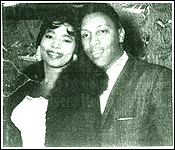
|
By Eric Lenaburg
Less than three weeks before the first anniversary of the plane crash that killed Buddy Holly and Ritchie Valens, and some
32 years before a presidential candidate made it one of
America's most famous small towns, Hope, Arkansas was
the site of a horrific car accident. Though very few fans
of modern rock and pop music are aware of it, the crash snuffed out the life and career of Jesse Belvin, a major
figure in the fusion of black soul and white folk music.
It is strange that Belvin's passing is rarely noted or even
mentioned in written histories of American music.
He co-wrote one of the biggest hits of the 1950s --- "Earth
Angel," a hit for The Penguins in 1955 --- and his
recording of "Goodnight My Love" was used by Dick Clark
as the closing theme for "American Bandstand" for several
years.
Belvin was a golden-voiced crooner who could be
a Nat King
Cole clone on Tuesday, singing "Guess Who?" and "Old
Man River," only to out-Elvis Presley himself on
Wednesday, with tunes like "By My Side" and "Just To
Say Hello."
In fact, it was that very talent for his
emulation of Presley
and Little Richard that caused RCA Records to sign Belvin and begin a unique promotion in 1959.
It would be a few years before the civil rights
movement built
up momentum, and RCA wanted badly to tap into the segregated
South, by offering a "Black Elvis." This was ironic,
indeed; early promotional material for Presley often called him "The White Soul
Singer" or "A White Little Richard."
The fatal car crash came less than four hours
after Belvin had performed the first integrated concert --- that
is, to an integrated audience --- in Little Rock. It
had been an ugly scene: White supremacists managed to
halt the show twice, shouting racial epithets and urging
the white teenagers in attendance to leave at once.
There had been at least six death threats on
Belvin. So, speeding
away from Arkansas was truly a relief, and a cause
for celebration.
"It was eerily reminiscent of a 1956
integrated concert in Alabama, when the legendary Nat "King" Cole returned to
his own hometown for a concert. Anticipating a warm reception --- after all, by
this time Cole had reached iconic status, had his own television show, and was
seemingly beloved by white audiences --- and he was returning to the very roots
of his youth. "Yet, less than 20 minutes into the set, Cole and his band
were quite literally chased from the stage and beaten. Cole never did come to
grips with that horrible night, and vowed never to return to the stage in
Alabama - a promise he kept right up until his tragic death from Cancer."
Belvin's wife, JoAnn, died from her injuries at the Hope Hospital,
while his driver --- like Jesse --- died at the scene.
As word reached the black community in Belvin's hometown, Los
Angeles, there were immediately rumors of foul play.
One of the first state troopers on the accident
scene stated that both of the rear tires on Belvin's black Cadillac had been "obviously tampered with." He gave no more
details, causing even more speculation. The fact that Belvin had phoned his mother twice in the last three days,
every time telling her about the hostile receptions he
received, made suspicions stronger: He rarely called home
from the road, and never more than once a month.
Belvin's two children were left orphans, until their paternal
grandmother agreed to assume legal custody.
In passing, Belvin left behind a legacy of
brilliant songwriting
as well as a plethora of doubts and confusion.
It seems unlikely his story would go untold until the end of the century, even as Holly and Valens were
resurrected and immortalized as Rock Gods. Yet, of 500 people surveyed, only one knew who Belvin was, while
just seven thought they had heard his name before.
The scorched earth on the highway at Hope was
still visible
in 1980, leaving us with a sad and painful vacuum,
close to the heart of rock and roll.
It is obvious Belvin has been relegated to the
end of the
rock legend line ... but the quest to make his story
known is ever-thriving. We only hope it will one
day be told.
Copyright 2003 by Eric Lenaburg |