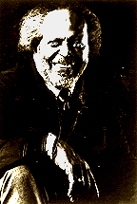
NY Times, Sunday, Feb. 14,
1999 p. 44
Jazz Artist Jaki Byard Died
of Bullet Wound
A jazz musician who was found dead in his Queens home on Thursday
night was killed by a gunshot wound to the head, police said.
Jaki Byard, 76, a prolific pianist who once toured Europe with
Charles Mingus, was killed by a single bullet that entered through his nose, the New
York City Medical Examiner said on Friday.
Paramedics, responding to a 911 call, found Mr. Byard dead at 11:45
PM at the home on Hollis Avenue that he shared with two of his daughters, the police
said. Investigators said he was last seen by his family at 6 PM on Thursday and that
he was killed about four hours later.
Detective Joseph Pentangelo, a Police Department spokesman, said no
weapon had been recovered and that investigators had no motive or suspects in the slaying.
There were no signs of robbery, forced entry or a struggle, Detective Pentangelo
said.
One of the jazz world's most enduring and eclectic musicians, Mr.
Byard played as recently as two weeks ago at a club in Boston. He was best known for his
unabashed mixing of styles and a witty stage presence that charmed audiences. He recently
recorded a compact disc with the musician Michael Marcus, to be released in March.
Writing in The New York Times in 1989, Peter Watrous called Mr.
Byard "one of jazz's great surrealists, a comic who hasn't a moment's fear of
disturbing the sanity of the performance." Mr. Byard could carelessly switch
from bebop to swing to funk.
In the 1960's, he frequently collaborated with Charles Mingus,
Charlie Mariano, Booker Ervin and Don Ellis. In the 1970's his big band,
the Apollo Stompers, was a regular on the Greenwich Village jazz circuit.
A woman who answered the phone at Mr. Byard's home last night
said that the family was too upset to talk. "We're all just in a state
of shock right now," she said.
By PETER WATROUS
NEW YORK -- Jaki Byard, a pianist, saxophonist and teacher who recorded with some of
jazz's most important figures, was shot dead Feb. 11 in his house in Queens, said his
daughter, Denise Byard-Mitchell. He was 76.
A police
investigation is continuing. Ms. Byard-Mitchell said that the family was baffled by the
killing, and that she and other family members had been home when Byard died and had heard
nothing.
Byard was an
extremely important figure in modern jazz for several reasons. In his playing he spanned
the history of jazz, and his improvisations, filled with quick stylistic changes, moved
from boogie-woogie to free jazz. He was a stylistic virtuoso, his fecund imagination saw
comparisons and contrasts everywhere, and his improvisations were encyclopedic and
profound. He also had a sense of humor that rippled through everything he
played.
"I
played Bud Powell solos, and that was a phase," Byard once said in an interview with
one of his students, the saxophonist Marty Ehrlich. "Then there was Garner, and that
was a phase, and then Tatum, and then finally I decided to put everything together and say
the hell with it, this is it."
It made him
the perfect accompanist for two of the more well versed musicians of modern jazz, Charles
Mingus and Rahsaan Roland Kirk , and Byard was one of the few jazz pianists capable of
keeping up not just with their stylistic references, but also with their humor and
volcanic intensity.
Byard also
taught for several decades and brought his cross-generational sensibility to his
students. The re-evaluation of jazz history that began in the late 1970s and early
1980s was partly due to Byard's encouragement and example.
Byard was,
early in his career, an integral part of a little-known jazz scene in Boston. During the
late 1940s he worked with the tenor saxophonist Sam Rivers in a band, and worked society
jobs, sometimes with the violinist and trumpeter Ray Nance.
He then took
a job with the alto saxophonist Earl Bostic in 1949, and when he returned to Boston he
performed as a solo pianist, and later joined the big band led by Herb Pomeroy, one of
Boston's most important bands.
In 1959 he
joined Maynard Ferguson's orchestra for two years. Also that year he met the saxophonist
Eric Dolphy, and recorded with him on the album "Outward Bound."
In 1961
Dolphy procured Byard's first recording date for Prestige records, producing "Here's
Jaki," which featured the Boston-based drummer Roy Haynes.
Byard also
worked with the innovative trumpeter Don Ellis. For the rest of the 60s Byard became the
pianist of choice for one of jazz's many vanguards.
In the early
1960s he started recording with Mingus, and his playing can be heard on "The Complete
Town Hall Concert," from 1962, and the two classic albums Mingus recorded for
Impulse, "Mingus Mingus Mingus Mingus Mingus" and "The Black Saint and the
Sinner Lady."
In 1963 he
recorded and worked with the tenor saxophonist Booker Irvin, another Mingus associate, and
with Charlie Mariano. Two years later he began an association with Kirk, recording and
performing with the saxophonist.
During this
time Byard began teaching at the New England Conservatory of Music, where he became an
important figure in jazz education. He recorded regularly until his death, and when Duke
Ellington became ill at the end of his life, filled the piano chair in the Ellington
Orchestra.
In the late
1970s Byard led the Apollo Stompers big band in Boston and New York, and he continued
teaching at the New England Conservatory and at the Manhattan School of Music, along with
stints at Bennington College, the Hartford School of Music, the Brooklyn Conservatory, the
University of Massachusetts and others.
In addition
to Ms. Byard-Mitchell, he is survived by another daughter, Diane, and a son, Gerald, all
of Queens, four grandsons and six great-grandsons. |