This Biography is from Brian
O'Connor of
Founder Delta Blues . Com
Born: December 23, 1908, Died:
November 4, 1998
Eugene Powell was born on December 23, 1908
in Utica, Mississippi, a small town
approximately 25 miles southwest of Jackson
in Hinds County. Shortly thereafter, his
parents Arma and Rosie Powell moved to a
plantation, at Lombardy in the Delta, near
Shelby, Mississippi. While at Lombardy,
Eugene began to play guitar at the age of seven.
Together with his half brother Ben on a mandolin,
Eugene began to play as a novelty
act at picnics and suppers and for prisoners
at Mississippi State Penitentiary. In 1915,
Eugene's half brother, the late Bennie "Sugar"
Wilson, may have been the inspiration
for Eugene to learn the banjo-mandolin too.
The Powell Family, again, moved to Hollandale
in Washington county in the early 1920's.
This is when Eugene Powell began his formative
years with the Chatmon Family.
The beginning of the musical Mississippi heritage
for Eugene Powell was also the
beginning for Charley Patton and Walter Vincson.
They got their musical apprentice-
ship from an ex-slave fiddle player named
Henderson Chatmon.
He was the father of the Chatmon Family whose
sons formed the group, The
Mississippi Sheiks. Eugene Powell grew
up with the Chatmon Family when they
moved from Bolton, Mississippi - Central
Mississippi, to Hollandale in the Delta in
the 1920's. It was in Hollandale where
Eugene Powell's instrumental interplay
began with Henderson Chatmon and his sons
Bo, Lonnie, Ty, Harry, Sam, Willie,
Bert, Lamar, Edger and Charlie. Eugene
Powell became a sometime member
and recording member of The Mississippi Sheiks.
Mississippi's most
commercially successful Blues artist.
The Eugene Powell Family and the Chatmon Family
worked on the Kelly Drew
Plantation in Hollandale together.
The true professional of the Jackson Blues,
Delta Blues and Forty-Fours were Eugene Powell
and his playing partners, the
Chatmons, Richard "Hacksaw" Harney and Ernest
"44" Johnson. Eugene Powell
played many instruments: banjo, guitar,
harmonica, horn, mandolin, violin, and
played lead most of the time when accompanied
with another musician.
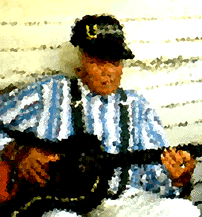
Eugene Powell's guitar was a Silvertone and
he inserted an aluminum resonator
into it like those found on the National
guitar. He also fitted a seventh string,
using the 12 string models as his inspiration.
The extra string was a 'C' an
octave higher than the conventional string.
By the end of the 1940's, Eugene played rarely
as new styles and trends
subjugated his abilities and left him unappreciated.
Understandably, Eugene does not have the spark
of his earlier playing,
but his Country Delta sophisticated playing
style stands out as being one
of the greatest Blues soloists and accompanists
of his time.
 .....Nov.
4, 1998
.....Nov.
4, 1998