|
WORD FOR WORD / MARK DAVID CHAPMAN
Vanity and a Small Voice Made
Him Do It **(editorial
link)
By
DAVID M. HERSZENHORN NY Times
On Dec. 6, 1980, Mark David Chapman boarded a plane in Hawaii for New York
City, where he planned to win infamy by murdering a Beatle. He had a .38 caliber
revolver tucked in his luggage and, by his own account, "a small voice"
in his head telling him to kill. Two days later, John Lennon was shot dead.
On Oct. 3, Mr.
Chapman had his first parole hearing at the Attica state prison, where he is
serving 20 years to life. He told the three parole commissioners in a 50-minute
interview that he had no expectation of going free and had even considered not
submitting the paperwork requesting a hearing.
"I filled it
out to follow procedure because you have a right to talk to me,"
he said. "You have a right to know what happened. We're
accountable to the people, to talk. So that's why I'm
here."
But the transcript
suggests many motivations: to explain, to show off
his newfound religion, to address his portrayal by the news
media, to apologize and, perhaps, to briefly recapture the
spotlight he so desperately craved. Excerpts follow.
The commissioners
began by recounting the circumstances
leading up to the murder.
Q. Can you please
tell us what you were thinking about at the time and
why you would do something so horrible?
A. I, um, flew
to New York a few months before that to do that crime with
full meditation in my heart. I then was able to somehow turn
myself around and came back to Hawaii, and I told my
wife that all was fine. And then the urges started building
in me again to do this crime, and I flew back to New
York on December 6th and checked into a hotel, and then
on the day of December 8th, stayed outside the
Dakota waiting for him with intent to shoot and kill him.
. . .
Q. Mr. Chapman,
have you given thought . . . as to what's behind all of
this and why you were so possessed with doing such harm
to this person?
A. I was feeling
like I was worthless, and maybe the root of it is a self-esteem
issue. I felt like nothing, and I felt if I shot him, I
would become something, which is not true at all.
Q. Mmm. hmm.
A. But that's why I
shot Mr. Lennon. Q. And him in
particular because he was someone that you admired or you
looked at him and his stature and you thought this
would have some impact on your life, sir?
A. I was in the
library . . . and I came across a book called "One Day at
a Time," and I saw him there with photographs
in front of his residence, the Dakota, and I was full of
anger and resentment. I took it upon myself to judge him falsely
for for, you know, being something other than,
you know, in a lotus position with a flower. . . . So it started
with anger, but I wasn't angry the night I shot him.
At another point,
Mr. Chapman was asked about the details of the
murder and how he financed his trip to New York.
Q. How far away
were you when you fired the shots?
A. Ten, 15 feet.
Q. You knew the
devastation?
A. Um, I knew
death would occur. I knew that I was probably not
going to be killed. Did I see the whole range of consequences?
No. . . .
Q. Where did
you get the money? You mentioned selling a painting for
all this.
A. I had a Norman
Rockwell lithograph that I sold.
Mr. Chapman,
who acknowledged having a list of other celebrities
he thought of killing (the names were blacked out in the transcript),
was asked whether he heard voices.
A. Probably right
toward the end, I heard a small voice, but I wasn't hearing
voices.
Q. What small
voice did you hear?
A. Just do it.
Q. Who was that
voice do you think?
A. Probably something
very evil, but I did it.
Q. We understand
that you did it.
A. I didn't
do it because voices told me to do it. That was a misunderstanding
from the very beginning, and that's not true.
The commissioners
wanted Mr. Chapman to describe his two decades
in prison, including his apparent mental breakdowns and
episodes in which he refused to eat for days at a time.
Q. How do you
think you have improved yourself in the prison setting,
sir? . . .
A. I, over the
years . . . have gotten relatively slowly but surely on a
more even keel mentally. I attribute that to God, and I attribute
that to being by myself for a number of years and
just having time probably alone and to think this out. And
toward the end of the 80's, I just started clearing up.
I had a clear mind. I didn't feel I was schizophrenic,
and I put down for the family reunion program, and
people started coming to see me on a regular basis.
I became, if you will, more religious. And in the 90's, I
kept on getting better and better and clearer and clearer.
. . .
Mr. Chapman,
when asked about his future if released, talked of possibly
working on a farm.
Q. Where are you
planning to live if you are paroled . . .?
A. Well, I wrote
down there that I would immediately try to find a job,
and I really want to go from place to place, at least in
the state, church to church, and tell people what happened to
me and point them the way to Christ.
Q. Have you given
thought to your own safety?
A. I feel like
God would protect me. . . . I would still be practical. I
wouldn't work at McDonald's.
At several points
the commissioners focused on Mr. Chapman's desire
for notoriety.
Q. Society tends
to acknowledge people and recognize people through
their accomplishments. . . Apparently you had a very skewed
thought in terms of how you would be acknowledged.
A. Yes, sir,
it was skewed. It was wrong.
Q. So it was a
vanity for you as well?
A. Absolutely.
Q. You wanted
attention?
A. Sure.
Q. Widespread
attention?
A. Yes, sir.
Later, Mr. Chapman
expressed regret for giving a 1987 interview to
People magazine and insisted that despite speaking with
Barbara Walters and Larry King, he has denied most
requests. He complained about being quoted out of context.
Q. Are there
any other areas you feel you should straighten out,
as you put it, any false perceptions that you feel?
A. Yes, sir.
I don't think I'm a celebrity. A chimpanzee could have done
what I did.
Q. Being a chimpanzee
that doesn't mean you are a chimpanzee or
not a chimpanzee.
A. What I mean
is there was no skill in what I did, and anyone could
have done this. Anyone could have pulled the trigger, and
I'm nobody special, and I just wish it was that way. Unfortunately
it's not, but I do wish I was a big nobody again.
. . . I wish this had never happened.
Given the chance
to make a closing statement, Mr. Chapman apologized.
What I did was
despicable. . . . I don't feel it's up to me to ask to be let
out. Again, I believe that once you take a person's life,
that's it. . . .
I'd like to take
the opportunity to apologize to Mrs. Lennon. I've
thought about what it's like in her mind to be there that night,
to see the blood, hear the screams, to be up all night
with the Beatle music playing through her apartment window.
. . .
I feel that I
see John Lennon now not as a celebrity. I did then. I saw
him as a cardboard cutout on an album cover. I was very young
and stupid, and you get caught up in the media and the
records and the music. And now I I've come to grips
with the fact that John Lennon was a person. This
has nothing to do with being a Beatle or a celebrity or
famous. He was breathing, and I knocked him right off his
feet. . . . I don't have a leg to stand on because I took
his right out from under him, and he bled to death. And I'm
sorry that occurred.
And I want to
talk about Mrs. Lennon again. I can't imagine her pain. I
can't feel it . . . I saw an article in Newsweek about three
months ago. . . . She said on that night that she was shaking
uncontrollably. And I think for the first time I really
realized, you know, the pain that I caused. I mean, here's
a person that can't control their body, and that really
hit home. . . . I originally wasn't going to come here after that
article I read, because of the shaking uncontrollably.
That bothered me. And I think it really hit home. Again, I'm not
saying these things for for you to give me any kind
of consideration of letting me go. I'm saying that because
they are real, and it happened to me, and I felt her pain
then and I can honestly say I didn't even want to feel it up
until then. It's a horrible thing to, you know, realize what
you've done.
The parole board,
which usually issues its decisions within a day or two,
rejected Mr. Chapman's application a few hours later.
He becomes eligible for parole again in October 2002. |

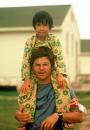 Mark
David Chapman, killer of John Lennon, gives an unidentified Vietnamese
child a ride on his shoulders in 1975 at Fort Chaffee near Fort Smith,
Ark. Chapman was at the Army base with YMCA during Vietnamese relocation
efforts. Chapman has almost finished his minimum sentence of 20 years in
prison for the slaying of Lennon in 1980, and will have his
Mark
David Chapman, killer of John Lennon, gives an unidentified Vietnamese
child a ride on his shoulders in 1975 at Fort Chaffee near Fort Smith,
Ark. Chapman was at the Army base with YMCA during Vietnamese relocation
efforts. Chapman has almost finished his minimum sentence of 20 years in
prison for the slaying of Lennon in 1980, and will have his  Mugshot