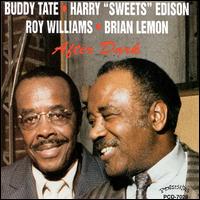
Buddy Tate
Jazz saxophonist whose
relaxed grace and lyricism were born in the swing era
John Fordham
Monday February 12, 2001
The Guardian
Jazz often confirms that the most wilfully egocentric performer can produce the most
sensitive and hospitable music; but if ever temperament and style faithfully mirrored each
other, it was in the case of the great swing saxophonist Buddy Tate, who has died aged 87.
One of the most relaxed, humorous and amenable of musicians, Tate's personal style was
glowingly reflected in the lissom and occasionally gently mocking elegance of his
saxophone playing.
Like many of the lyrical and romantic jazz performers of his era, Tate could perform
miniature miracles with minimal materials, and to hear him embroider a ballad like I Can't
Get Started in unaccompanied performance, merely shuffling a handful of soft, buttery
notes and mingling them with a textural repertoire of intimately whispering intonations,
was one of the most agreeable experiences in postwar jazz. But Tate could also be an
exciting, hard-swinging player too, and his control of the horn in its upper register
predated many of the technical advances in saxophone playing that were made by the
modernists in hard bop and the avant garde.
Tate came up in the 1930s when swing ruled popular music and instrumental stars were
heroes whose reputations were not far behind those of singers. But the connection between
the song and the sound of a saxophone, trumpet or clarinet was closer then. Bebop, with
its intricate, cliffhanging melody lines and unpredictable resolutions had not yet arrived
to launch a jazz sound very different to the shapely lyricism of vocalised instrumental
methods that mimicked singing. Tate therefore learned from the examples of saxophonists
Coleman Hawkins, Lester Young and Herschel Evans. Young's favourite query to an improviser
who strayed too far from the fundamentals of the song was "What's your story?"
That accessible notion of an improviser's narrative was Tate's too.
Tate began working with the territory bands that travelled around the southwest in the
tough years following the Depression and before swing took off. He worked with McCloud's
Night Owls, the St Louis Merrymakers and a band led by Terrence Holder that was later to
be taken over by the celebrated Andy Kirk.
Tate worked briefly for Count Basie on Lester Young's temporary departure, but this
early incarnation of the Basie band soon broke up for want of bookings. But Basie's chance
came again when swing became a national craze around the mid 1930s, and in 1939 Tate got
his big break when was invited to join the now successful Basie orchestra following the
sudden death of tenorist Herschel Evans. The two had been old friends and Tate maintained
later that he had dreamed Evans had died before he ever heard the news, and was sure that
a call from Basie would come. For Basie's part, the bandleader said in his autobiography:
"Buddy was enough like Herschel, so he could take care of that business, but he also
had his own thing, which meant we still had two different styles, tones, and
everything." Tate stayed with Basie for nine years, until postwar economics forced
changes in the line-up and the saxophonist decided to look for work that would keep him
closer to New York. Tate played for bandleaders Lucky Millinder and Hot Lips Page, and in
Basie singer Jimmy Rushing's Savoy band. He eventually secured a residency at the
Celebrity Club on 125th Street in Harlem, and stayed for 21 years until the rise of
jazz-rock and the eclipse of mainstream in the 1970s.
Tate nevertheless continued to record regularly, toured with the irrepressible swing
trumpeter Buck Clayton and kept himself in the public eye by preserving a Basie-influenced
small-group music that was affectionately received by every kind of jazz audience.
He also appeared with Jay MacShann, the bandleader in whose outfit the young Charlie
Parker's tentative bop experiments were first heard, and with trombonist Al Grey, a
musician with much of Tate's own relaxed grace and lyricism.
Tate was badly scalded in an accident in 1981, but returned to playing through the 80s
- sometimes with a hard-swinging ensemble also featuring the driving blues-influenced
tenorist Illinois Jacquet and called the Texas Tenors.
• Buddy (George Holmes) Tate, saxophonist, born February 22, 1913; died February
10 2001 |
|
NY TIMES
Buddy Tate, Saxophonist for Basie's Band, Dies at 87
By BEN RATLIFF
Buddy Tate, a broad-toned saxophonist who was a vital part of the widely
admired Count Basie band of the 1940's, died on Saturday in Chandler, Ariz. He was 87.
Mr. Tate was one of the great tenor saxophonists of the swing era, a
superbly sophisticated ballad player influenced by both the diaphanous tone of Lester
Young, his section mate in the Basie orchestra, and by the urgency and rhythmic
muscularity of Coleman Hawkins. These traits could be heard in his first recorded solo
with Basie's band, "Rock-a-Bye Basie" from 1939, which Mr. Tate felt was one of
his best. His force and his flights into the horn's high registers identified the Texas
tenor style, also exemplified by the saxophonists Arnett Cobb and Illinois Jacquet.
Born George Holmes Tate in Sherman, Tex., he began his career in the late
1920's, playing around the Southwest with bands led by Terrence Holder, Andy Kirk and Nat
Towles. He played briefly with Count Basie in 1934, then began his 10-year association
with the Basie orchestra in 1939, after the death of its saxophonist, Herschel Evans. It
was his work with Basie that most assured him his place in jazz history.
In the 1950's Mr. Tate played with Lucky Millinder, Jimmy Rushing and Hot
Lips Page, and in 1953 he began to lead his own band, which played a regular show at the
Celebrity Club in New York for more than 20 years. He worked often in Europe, playing with
Jim Galloway, Jay McShann and Al Grey.
In the late 60's he recorded in France with the organist Milt Buckner and
the drummer Wallace Bishop. He and the saxophonist Paul Quinichette were co-leaders of a
band at New York's West End Cafe; Mr. Tate led another band with the drummer Bobby
Rosengarden at the Rainbow Room in the 70's.
Mr. Tate's career of playing and recording, mostly at selected festivals
and with touring groups like the Statesmen of Jazz, lasted through the mid-90's, with a
final appearance on "Conversin' With the Elders," the 1996 album by the young
saxophonist James Carter.
Mr. Tate lived in Massapequa, N.Y., until a few weeks ago, when he moved
to Phoenix to live with his daughter Georgette. She survives him, along with another
daughter, Josie, also of Phoenix, and many grandchildren.
|
|