|
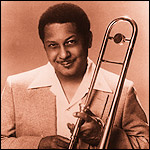
Britt
Woodman, Noted Trombonist For Duke Ellington, Dies At 80
Trombonist Britt Woodman, who was one of the sturdy pillars of
the Duke Ellington big band in the 1950s, died Friday (Oct. 13) in
Hawthorne, Calif., after a battle with respiratory illness. He
was 80.
In 1951, Woodman replaced the highly-regarded Lawrence Brown as
first trombonist in the Ellington orchestra, and earned the respect of
his bandleader, his fellow musicians, and jazz fans for generations to
come.
"He was always one of my inspirations, a good friend," says trombonist Steve Turre, who featured Woodman on his albums Steve Turre and Rhythm Within. "As far as playing the
trombone goes, he was top shelf. His chops were ridiculous.
He was a grand master, and just a sweetheart."
Trombonist Wayne Goodman, who played beside Woodman in the
Lincoln Center Jazz Orchestra, recalls Woodman's reputation
among the younger players. "If he wasn't like a father-figure,
he was certainly like a grandfather figure," says
Goodman. "Ever since I found out who Duke Ellington was,
I found out who Britt Woodman was, and he's always had
that kind of special ranking to me. Listen to any one of those
records that he's on with Duke, and hear him play -- and
that's enough."
Britt Bingham Woodman was born in Los Angeles June 4,
1920, to a musical family. The teenaged Woodman, who played
piano, tenor sax, and clarinet as well as trombone, joined
a family band with his brothers. His first few years as a
professional musician were interrupted by military service during
World War II, but in 1946, he joined the innovative orchestra of Boyd Raeburn. Gigs with Eddie Heywood and Lionel
Hampton followed, before Woodman attended Los Angeles'
Westlake College from 1948-50.
During Woodman's tenure with the Ellington orchestra, he appeared
on Blue Moods, an unusual, one-off Miles Davis recording
date for Charles Mingus' Debut Records, where Woodman
backed the trumpeter along with Mingus on bass, Teddy
Charles on vibraphone, and Elvin Jones on drums. In a career
that spanned many decades, Woodman was featured on
albums by Dizzy Gillespie, Ella Fitzgerald, Oscar Peterson, Jimmy Smith, Sarah Vaughan, Rosemary Clooney, and many
others.
Woodman joined up with Mingus in 1961, and later played in the
ensembles of such leaders as Benny Goodman, Quincy Jones,
Benny Carter, Chico Hamilton, Oliver Nelson, Nelson Riddle, and the Toshiko Akiyoshi-Lew Tabackin big band. Woodman,
who alternated between living in New York and Los
Angeles, remained highly active through the 1990s, where he appeared with such bands as the LCJO, the Mingus Big
Band, and David Berger's Sultans Of Swing.
In recent years, Woodman had returned to his family in Los Angeles
as he coped with the respiratory problems that would
ultimately claim his life. A widower who had no children,
Woodman is survived by his brothers, Coney, William,
and George Woodman.
-- Drew Wheeler |
|
Britt Woodman; Key L.A. Jazz Figure
Played
Trombone With Duke Ellington
By JON THURBER, Times Staff Writer
Britt Woodman, an important figure in the growth
of the vibrant Los Angeles jazz scene
in the 1930s and '40s, who became more widely
known for his work as a trombonist with Duke Ellington's Orchestra
a decade later, has died.
Woodman died Friday at Robert F. Kennedy
Medical Center in Hawthorne, according
to his niece Beverly Woodman. He was 80 and
had been suffering from severe respiratory problems. In
a career that encompassed one of jazz's most unusual musical journeys,
Woodman was active in the late '30s in such swing-oriented ensembles
as the Les Hite Band.
He also played with the iconoclastic Boyd Raeburn Band of the mid-1940s
before becoming a stalwart of the Duke Ellington Orchestra
trombone sections in the 1950s. With Ellington, he was featured
on numbers such as "Sonnet To Hank V" (from "Such Sweet
Thunder") and "Red Garter" (from "Toot Suite").
Woodman's versatility was such that he was
comfortable in almost any setting. He
recorded with Miles Davis; worked frequently with
Charles Mingus (he is present on the classic recording "Mingus, Mingus,
Mingus"); was a member of the brass section for John Coltrane's
"Complete Africa/Brass Sessions;" played in a long list of big
bands, including the Lincoln Center Jazz Orchestra; and was active
in the studios as well as in orchestra pits for theatrical musicals.
"Woodman was a consummate sideman, his
professionalism apparent in his
capacity to deal with such a wide array of musical demands,"
said Don Heckman, The Times jazz writer. "But he was also
a first-rate improviser, with a highly personal style."
Born in Los Angeles on June 4, 1920, Woodman
grew up in Watts as a member of a
musical family. His father, a trombone player, believed
that as the country entered the Depression, the best financial opportunities
for his sons would come from making music.
Britt Woodman started playing piano at age 7. A
short time later his father gave him a
trombone, and then a saxophone and a clarinet. By
the age of 15, Woodman was playing professionally in a group with
two older brothers: the Woodman Brothers Biggest Little Band in
the World.
They were so versatile and proficient as
musicians that they often traded
instruments in the middle of a set. It was not uncommon, for instance,
for Britt Woodman to begin a set playing alto saxophone and
then switch to trombone and finally to clarinet.
His older brother William--who had a
professional career as a tenor
saxophonist--also played clarinet and trumpet. A third brother, Coney,
played piano and banjo. Their father managed the group, handled
the bookings and arranged the music.
In the book "Central Avenue Sounds," a history
of the flourishing jazz scene near
Central Avenue around World War II, William Woodman
Jr. recalled that he and his brothers were well known among
local musicians.
"We were recognized because we were the only
musicians who doubled on three
instruments," he said. "You didn't hear of anybody doubling
on brass."
After the band split up about five years later,
Britt Woodman played in a variety of
clubs on Central Avenue, including the legendary Club Alabam.
One of the clubs he worked in, he recalled in
"Central Avenue Sounds," was owned by
the gangster Mickey Cohen. "Our payroll checks
were signed by him," Woodman said.
Woodman served in the Army during World War II
and studied music on the GI Bill at
Westlake College after his discharge. He joined
Ellington a few years later and lived for the better part of his career
in New York City. When Woodman married in the mid-1950s, Mingus
was the best man. His wife, Clara, died in 1991. They had no children.
He was active professionally until 1997 when
his health declined. He returned to Los
Angeles earlier this year. Funeral arrangements were incomplete. ~ LA Times
|