Brian
O'Hara (b. Liverpool, Mar. 12, 1942)
Fourmost
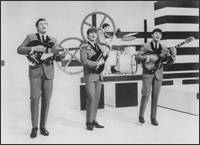
The Fourmost were originally known as the
Blue Jays, then the Four Jays, and then the Four Mosts, before finally
taking on the name under which they finally succeeded. Lead guitarist and
singer Brian O'Hara (b. Liverpool, Mar. 12, 1942) and rhythm guitarist
and singer Mike Millward (b. Bromborough, Cheshire, May 9, 1942) had a
pleasing attack on their instruments and sang well enough, even harmonizing
well, and with bassist-singer Billy Hatton (b. Liverpool, June 9, 1941)
and drummer (and sometime singer) Dave Lovelady (b. Liverpool, Oct. 16,
1942), the Fourmost were one of the better combos working Liverpool in
the early 1960's. They could rock hard, with a crisp guitar sound and vocals
that wailed convincingly, and Hatton's bass work had a nicely melodic
sound--the group lacked the distinctiveness
of Gerry & The Pacemakers at their best, but were never as sappily
sentimental as their major sub-Beatles Liverpool rivals could get, and
had a livelier, leaner, and more refined sound than such competitors as
the Swingin' Blue Jeans.
The Fourmost's fortunes took a sharp
turn upward in 1963 when they were given the nod by Brian Epstein and became
a part of his stable of Liverpool-based acts. Their bookings improved and
they were signed to EMI's Parlophone label, where they were recorded by
George Martin. The band also got access to a pair of Lennon-McCartney originals
("Hello Little Girl," "I'm In Love") that got them noticed, and they peaked
in April of 1964 with the single "A Little Lovin'," which got to No. 6
in England. Unfortunately, none of the Fourmost were songwriters, and this
left them at the mercy of outside inspiration and outside sources for songs,
which quickly dried up as dozens of rival bands started covering the same
material.
They also looked a bit stiff on stage and
on television, which was a problem as the bands around them got bolder
in their presentations. Additionally, like a lot of early Liverpool acts,
the Fourmost were oriented toward music careers that left room for cabaret-style
humor, believing--as had been the case before the Beatles--that a band
eventually branched out from straight ahead rock 'n roll.
Their music included a fair lacing of
comedy tracks amid perfectly respectable covers of numbers like "The In
Crowd" and "Some Kind of Wonderful." Once the music around them began maturing
in a different direction, into more advanced forms of rock 'n roll rather
than toward pop, they found themselves on the outside looking in--in 1965,
while the Beatles were taking the first steps into the druggy ambience
and the diverse folk and Indian sounds that would spice their second flourishing,
and the Rolling Stones were shaking up the airwaves with "Satisfaction,"
the Fourmost were covering "Why Do Fools Fall In Love" (a great song, to
be sure, but not exactly aiming high in ambition). With a few breaks and
more focus, they might've been a somewhat more pop oriented equivalent
to the
Action, but it wasn't to be.
The group never charted a single
after the spring of 1964, despite an attempt in the summer of the 1966
to piggy-back once more on the Beatles' work with a cover of "Here, There
and Everywhere." The death of Mike Millward from leukemia in 1966
doomed the band's prospects, although as late as 1969, Paul McCartney was
still throwing some help their way. By then, they were fixtures on the
cabaret circuit, and long since forgotten by most of the public. -- Bruce
Eder, All-Music
Guide
|
 Suicide:
Hanged
Suicide:
Hanged